

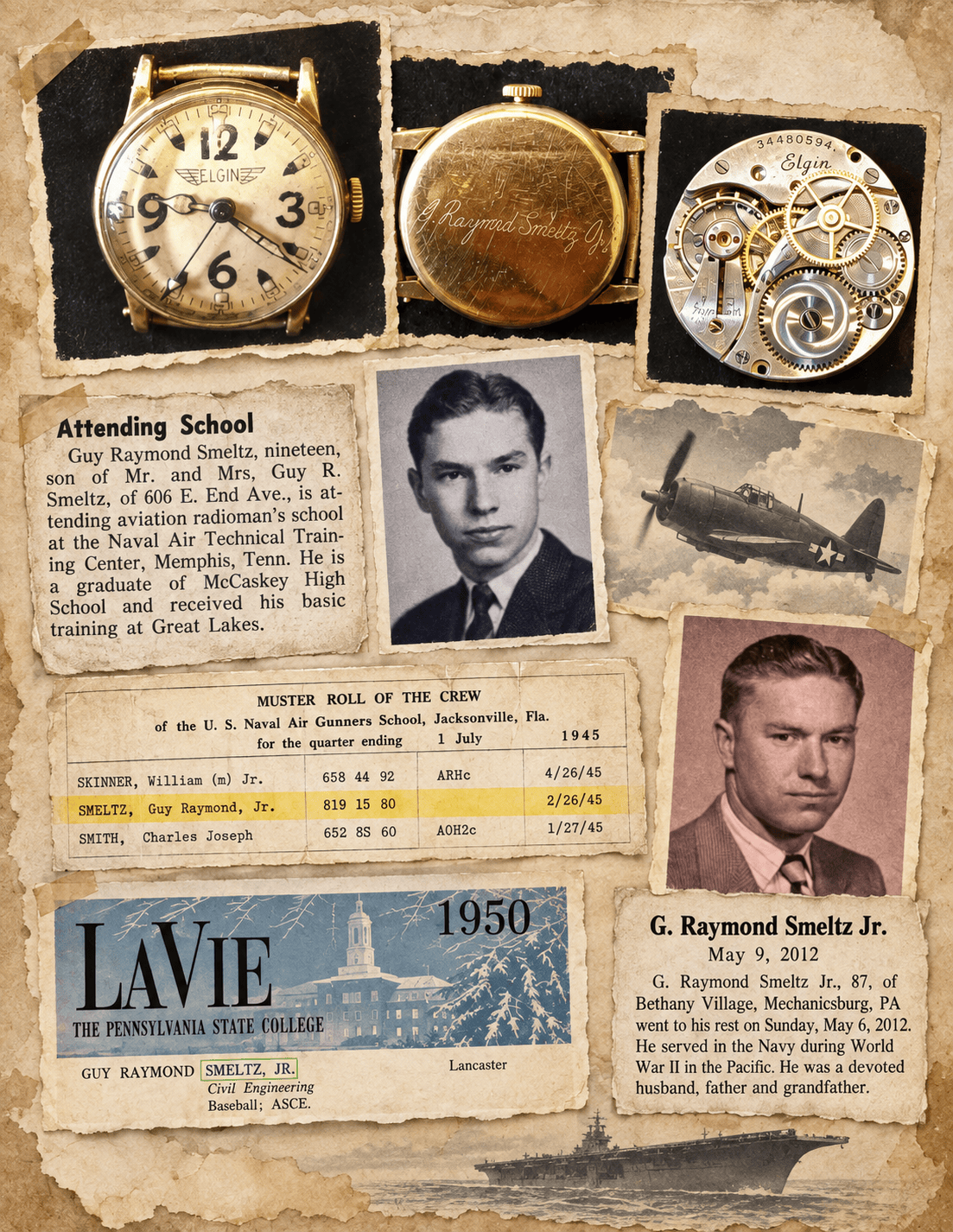
G. Raymond Smeltz Jr., Naval Aviation, and an Elgin Born for the Skies
There are watches whose history begins in a showroom. Others seem to find their way into lives that make the watch itself more interesting.
An early-1930s Elgin aviation wristwatch associated with G. Raymond Smeltz Jr. belongs to the second category.
Its dial is unmistakably from the age when American aviation was changing almost by the month: oversized numerals at 12, 3, 6 and 9, luminous markers, broad hands and Elgin’s winged aviation emblem spread across the center. The case is 10-karat gold filled, and inside is an Elgin movement bearing serial number 34,480,554. The watch surfaced decades later at an estate sale, its case worn and scratched in the way only a genuinely lived-with object becomes worn.
But the more interesting story is the name connected to it.
A Young Man Goes to War
Guy Raymond Smeltz Jr. was born in Lancaster, Pennsylvania, on October 2, 1924. He came of age at exactly the moment when the United States was being pulled into the greatest conflict in its history.
At nineteen, Smeltz was reported as attending aviation radioman’s school at the Naval Air Technical Training Center in Memphis, Tennessee, after receiving his basic training at Great Lakes. The surviving military research in the file places him within the world of U.S. naval aviation and later records his service during the Pacific war. The documents also connect him with aircraft-support organizations and wartime Navy assignments associated with carrier aviation.
He was not entering a glamorous Hollywood version of aviation.
Naval aviation depended on far more than the man sitting behind the controls. Aircraft had to be maintained, communications had to work, radios had to reach ships and bases hundreds of miles away, crews had to be trained, and an enormous technical network had to function correctly while operating under wartime conditions.
Men like Smeltz were part of that network.
The research file later records simply that he served in the United States Navy during World War II in the Pacific.
That single sentence covers years that must have seemed considerably longer to the young men living through them.
An Aviation Watch From Another America
By the time Smeltz entered naval aviation, the Elgin watch associated with him was already a product of an earlier aviation revolution.
Elgin had introduced the Avigo line around 1929, during the explosion of public enthusiasm for aviation following Charles Lindbergh’s Atlantic crossing. The watches used the distinctive four-numeral aviation-style dial — 12, 3, 6 and 9 — intended to make the time immediately readable. The research material also notes that Elgin used the Avigo name for aviation equipment beyond wristwatches, including aircraft-related instruments.
The surviving Smeltz watch has precisely the sort of visual language associated with that era: a large 12, 3, 6 and 9, luminous hour markers and an aviation-style winged emblem.
It is easy today to look at such a watch as a charming piece of vintage design.
In the 1930s, though, aviation was not retro.
It was the future.
And only a few years later, that future would be tested over two oceans.
From Naval Aviation to Engineering
Smeltz returned from the war and built a remarkably normal American life — which may be the most meaningful part of the story.
He attended Penn State University, earned a degree in civil engineering, and played baseball for the Nittany Lions. He went on to work as an engineer for the Pennsylvania Department of Transportation and later for Erdman Anthony Associates, eventually retiring after a long professional career.
He married Marian, and they spent 59 years together. They had three children and five grandchildren. He enjoyed golf, baseball and football, belonged to Trinity Evangelical Lutheran Church, and remained connected to his Pennsylvania community.
A newspaper story from later in his life caught an wonderfully ordinary glimpse of the man. After decades as an engineer and a wartime Navy veteran, retirement apparently gave him considerably more time for golf — enough that his wife joked she sometimes wondered when he would be home.
There is something reassuring about that.
The young sailor who entered wartime naval aviation got to become an engineer, husband, father, grandfather and golfer.
He got to come home.
What a Watch Can Carry
There is no need to pretend that a wristwatch makes a man courageous.
It doesn’t.
A watch simply goes where its owner goes.
And sometimes that is enough.
An old case becomes scratched. A dial changes color. Luminous paint darkens. A mechanical movement that once divided every day into seconds eventually falls silent.
But the object survives.
In this case, an American aviation watch survived alongside the name of an American who trained in naval aviation, served his country in the Pacific, returned home and spent the rest of his life building things rather than destroying them.
That gives the watch a significance no catalog description could have provided.
The People Behind the Wings
AVIGO began during an era fascinated by aircraft, records, speed and the men attempting things in the sky that had barely seemed possible a generation earlier.
But nearly a century later, the most compelling part of that history may not be the airplanes at all.
It may be the people.
Some became famous. Some set records. Some flew combat missions. Others kept aircraft flying, communications working and crews connected. Many returned home quietly and resumed lives that gave little indication of what they had once been asked to do.
G. Raymond Smeltz Jr. was one of those men.
His Elgin aviation watch is not important because it can make him a hero.
It is important because it reminds us that watches sometimes end up on the wrists of people whose lives give the watches meaning.
And perhaps that has always been the proper place for an AVIGO.


No comment