The Hunter Brothers, the City of Chicago, and the Flight That Would Not Come Down
On the morning of June 11, 1930, two brothers climbed aboard a Stinson-Detroiter at Sky Harbor Airport outside Chicago and took off with an idea that bordered on madness: they were going to remain in the air until they had broken the world endurance record.
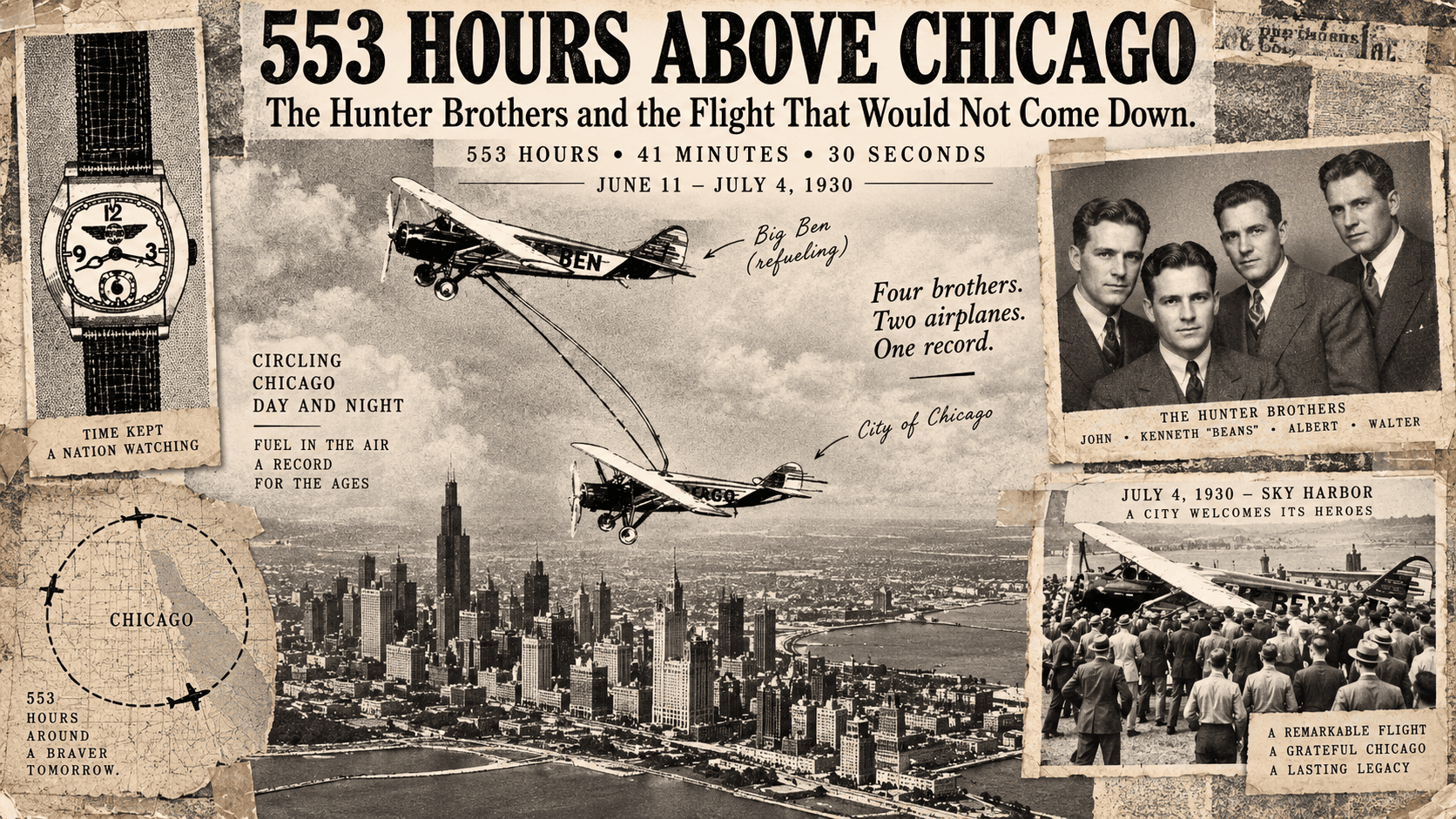
There would be no landing for fuel, no night in a hotel, no mechanic waiting in a hangar when something broke. John Hunter and his younger brother Kenneth “Beans” Hunter intended to live inside their airplane, the City of Chicago, while their brothers Albert and Walter kept them alive from another aircraft flying alongside. What followed became one of the great endurance spectacles of early American aviation: 553 hours, 41 minutes and 30 seconds without touching the ground. The Fédération Aéronautique Internationale later ratified the achievement as a world record.
Read the FAI history of the Hunter Brothers’ record flight
The numbers are extraordinary, but they hide what the flight actually demanded. Twenty-three days is long enough to turn a daring takeoff into an entirely different kind of existence. Day became night, night became morning, and the City of Chicago simply continued circling over the same Illinois countryside. The engine never got to cool. The pilots never got to step onto solid ground. Every meal, gallon of gasoline, quart of oil and replacement part had to somehow reach an airplane that was already flying.
Four Brothers, Two Airplanes, One Attempt
John and Kenneth occupied the record aircraft, but the Hunter Brothers’ achievement was never a two-man operation. Albert and Walter flew another Stinson-Detroiter named Big Ben, repeatedly climbing into position above the City of Chicago to deliver fuel and supplies. FAI records the roles clearly: John and Kenneth flew the endurance airplane while Albert and Walter formed the refueling crew. Together, the four brothers created an airborne system that had to keep functioning day after day.
The surviving film is remarkable. In footage from the summer of 1930, Big Ben can be seen maneuvering over the City of Chicago as a hose hangs between the aircraft. When the transfer is complete, the hose falls away and the airplanes separate. In another moment, one of the Hunters is visible outside near the nose inspecting the engine while the airplane continues flying.
Watch original 1930 footage of the refueling and in-flight engine inspection
This was the machinery behind the record. The public saw an airplane circling overhead, but the real accomplishment was maintaining an uninterrupted chain of fuel, oil, food, mechanical work and human concentration for more than three weeks.
The Airplane Became Their World
The City of Chicago had been specially prepared for endurance flying. According to surviving aircraft records, it carried enlarged fuel capacity and was inspected at Sky Harbor shortly before the attempt. The aircraft was purchased by John Hunter in June 1930, renamed City of Chicago, and equipped for the ordeal ahead.
Once the flight began, there was no such thing as an ordinary mechanical problem. A loose component that could have been fixed in minutes on the ground became a crisis in the air. The Hunters had anticipated some of this. Access points around the aircraft allowed Kenneth to reach portions of the engine and tail while the airplane remained airborne, and FAI records that he repeatedly went outside at considerable personal risk to inspect and repair the machine.
The aircraft did not simply carry two passengers for 553 hours. It became their bedroom, kitchen, workshop and workplace. John and Kenneth traded flying duties and tried to rest whenever they could, while Albert and Walter repeatedly returned in Big Ben. The support operation extended to the family on the ground as well. Contemporary TIME reporting after the flight specifically mentions their sister Irene, who had cooked for the brothers, and their mother Ida Hunter becoming part of the frenzy that surrounded the family once the record was over.
By the middle of the attempt, the flight had become more than an aviation experiment. It was becoming a public obsession.
America Started Counting With Them
People gathered beneath the circling airplane. Newspapers carried updates as the hours accumulated. The spectacle had the wonderfully strange quality of early aviation: everyone knew where the pilots were—they were right above Chicago—and yet they had effectively disappeared into another world.
A surviving July 2, 1930 newspaper report preserved by the Library of Congress announced that John and Kenneth had flown through their 500th continuous hour over Sky Harbor at 11:40 that morning. At that point, the newspaper reported, they were already approximately 80 hours beyond the previous world endurance mark.
See the July 2, 1930 newspaper report preserved by the Library of Congress
Five hundred hours should have been enough to satisfy anyone. The Hunters continued.
The longer the flight lasted, the stranger the accomplishment became. Twenty days in an airplane. Then twenty-one. Then twenty-two. The old endurance record was no longer the question. The question was how long the men—and the machine—could possibly continue.
An AVIGO Was There in the Story
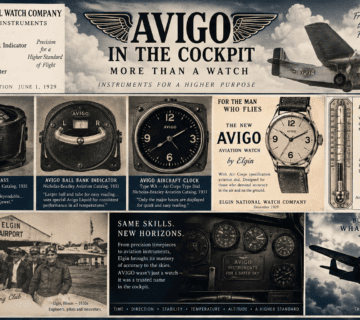
Only weeks after the flight, a Houston newspaper carried an advertisement celebrating what the Hunters had accomplished. The August 24, 1930 advertisement stated that the brothers had remained aloft over Sky Harbor for 553 hours, 41 minutes and 30 seconds and, critically for AVIGO history, said that the passing hours had been recorded with their AVIGO strap watch.
That distinction is important. This was not a modern watch company attaching itself retroactively to a famous flight. The AVIGO connection appeared in period advertising while the Hunter Brothers’ achievement was still fresh in the public imagination.
At the same time, there is a line we should not cross until more evidence is found. The advertisement does not identify which of the Hunter Brothers wore the watch, nor do we presently have the surviving Hunter watch in hand. Those are unanswered questions worth pursuing. What the evidence does establish is that AVIGO was publicly connected in 1930 with one of the most extraordinary endurance flights of its age.
That makes the Hunter story especially significant for AVIGO today. The watch appears not merely beside aviation imagery, but beside an actual aviation achievement involving four brothers pushing men, machines and logistics beyond what most people believed practical.
July Fourth: The Machine Finally Said Enough
By July 4, the Hunters had been in the air for more than three weeks. The airplane had endured hundreds of hours of continuous operation and repeated in-flight maintenance. Eventually, a problem developed that even their ingenuity could not sensibly overcome.
Contemporary TIME coverage published on July 14 described the final crisis: a clogged screen restricted the engine’s oil supply. Kenneth attempted to remove it for cleaning, but oil spurted out, forcing the brothers to abandon the attempt and land. When they finally came down, TIME recorded the new mark as 553 hours, 41 minutes and 30 seconds—more than 133 hours beyond the previous record.
Read TIME’s July 14, 1930 report on the end of the flight
The landing was anything but quiet. Thousands had gathered at Sky Harbor. Surviving footage shows the City of Chicago passing over the field before settling onto the grass as spectators begin running toward the aircraft. The crowd pours across the airfield, chasing the airplane as it taxis toward a hangar. John Hunter emerges covered in oil that had sprayed into the cockpit during the final mechanical trouble.
Watch the Hunter Brothers return to earth on July 4, 1930
For twenty-three days, people had stared upward.
Now the men they had been watching were suddenly standing among them.
553 Hours Was a Family Record
The headline naturally belonged to John and Kenneth because they were the two men who never touched the ground. But the deeper story belongs to all four brothers. Albert and Walter repeatedly put Big Ben alongside the record aircraft and delivered the supplies that kept the attempt alive. Without them there is no 553-hour flight. Without John and Kenneth there is no record. Without the family operation on the ground, the system begins to fall apart.
That is what makes the Hunter Brothers more interesting than a simple record-book entry. Four brothers created a miniature aviation operation in the sky and kept it running for more than three weeks.
FAI notes that the flight covered a distance equivalent to roughly one and a half trips around the world, while the National Aeronautic Association monitored the attempt so the record could be formally ratified. The City of Chicago itself reportedly accumulated roughly 40,000 miles during the endurance operation.
Yet there was almost no destination.
They simply kept flying.
What 553 Hours Means Nearly a Century Later
Early aviation history is filled with faster airplanes, longer routes and ever-greater records, which means numbers can eventually blur together. The Hunter Brothers’ flight is different because the human reality behind the number is so easy to understand.
Imagine waking up tomorrow and knowing you cannot touch the ground again for more than three weeks. Imagine sleeping beside an engine that never stops. Imagine your brothers appearing overhead carrying the gasoline that decides whether your attempt continues. Imagine discovering something is wrong with the airplane and knowing that the solution may involve climbing outside and repairing it while it is still flying.
Then imagine looking at a watch.
Another hour.
Then another.
Then another.
553 hours, 41 minutes and 30 seconds.
A surviving advertisement tells us that AVIGO was part of the way that story was told in 1930. Nearly a century later, that connection gives the Hunter Brothers a special place in AVIGO’s history—not because the watch created their achievement, but because it was associated with men doing exactly what aviation watches were meant to accompany: going farther, staying longer and refusing to come down until the job was finished.


No comment