Kenneth “Beans” Hunter and the 553 Hours Above Chicago
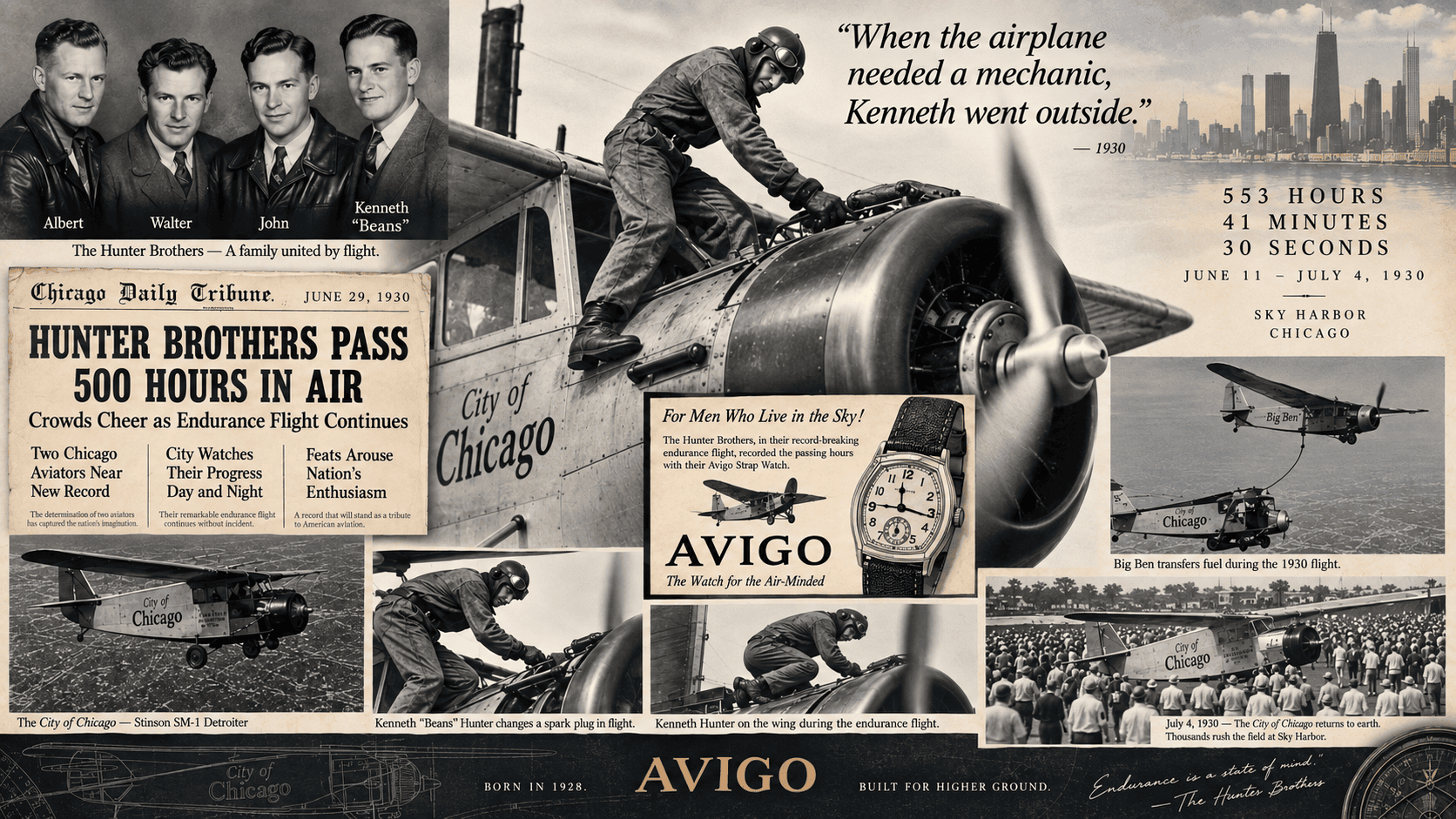
For more than three weeks in the summer of 1930, an airplane circled above Chicago and refused to come down. The aircraft was the City of Chicago, a Stinson-Detroiter flown by brothers John and Kenneth “Beans” Hunter, and with every additional hour they pushed farther beyond what both aircraft and pilots were ordinarily expected to endure. Fuel could be passed from another airplane. Food could be lowered aboard. One exhausted pilot could sleep while the other held the controls. But when the airplane itself began to fail, there was no hangar waiting in the sky.
That was when Kenneth Hunter did something almost unimaginable today.
The brothers had fitted external catwalks to both sides of the airplane so that repairs could be attempted without landing. When the engine or tail needed attention, Kenneth could leave the relative safety of the cabin and move outside the aircraft while it remained in flight. The Fédération Aéronautique Internationale describes him accessing the engine and tail at “great personal risk” to perform inspections and repairs during the record attempt. Read the FAI history of the Hunter Brothers’ record flight
And this is not simply a dramatic story passed down over the decades. The photographs still exist.
The Davis-Monthan Airfield Register archive preserves an extraordinary image of Kenneth standing on the catwalk surrounding the nose of the City of Chicago, with John visible inside the cockpit. The archive notes that the special catwalk and handholds had been installed specifically so key areas of the airplane could be reached in flight. Kenneth’s relaxed posture in the photograph almost disguises what is happening: the aircraft beneath him is airborne and moving at speed. See Kenneth Hunter on the catwalk during the flight
Even more remarkable, surviving motion-picture footage shows it happening. Film from 1930 shows the City of Chicago circling Sky Harbor, the refueling aircraft Big Ben approaching above it, a hose dropping between the two airplanes—and one of the Hunter brothers actually out on the nose inspecting the engine while the airplane remains in flight. Watch the original 1930 footage of the flight and in-air engine inspection
Eleven Days Wasn’t Enough
The record did not begin with success. In September 1929, John and Kenneth had already attempted to break an endurance record. They remained airborne for approximately eleven days before heavy fog made aerial refueling impossible and forced them down. For most pilots, eleven days continuously in the air would have been an accomplishment worth celebrating. For the Hunters, it became a lesson in what had to be changed before they tried again.
By the following summer, the operation had become a family mission. Brothers Albert and Walter were brought in to fly the support aircraft, Big Ben. The airplane John and Kenneth would fly was renamed City of Chicago, and on June 11, 1930, they took off from Sky Harbor Airport at Northbrook, Illinois.
This time, they intended to stay up.
At first, refueling contacts occurred roughly every six hours. After a leak developed in one of the fuel tanks aboard the City of Chicago, the interval reportedly shortened to about every three hours. Each rendezvous brought gasoline, oil, food, clean clothes and other supplies while both aircraft remained airborne. Their mother and sister Irene prepared meals and handled laundry on the ground, while John and Kenneth alternated between flying and trying to sleep inside an airplane that never stopped moving.
When the Airplane Needed a Mechanic, Kenneth Went Outside
The mechanical punishment was relentless. The engine was not being asked to run for a morning or an afternoon but day after day, through heat, vibration and hundreds of uninterrupted hours. Contemporary accounts later summarized the amount of repair work as substantial: spark plugs were changed, a magneto was overhauled, engine hardware was replaced, and lubrication had to be maintained while the aircraft continued flying. Kenneth made repeated trips along the catwalk to reach the engine, and he also ventured back toward the tail to remove debris that threatened the control system.
Think about what that meant physically. The engine was vibrating inches away. The propeller was turning ahead of him. Wind hammered against his body while the narrow catwalk carried him around the exterior of an airplane that could not simply stop if he slipped. There was no modern maintenance platform, no enclosed work area and no runway beneath his boots.
Yet landing meant ending the attempt.
So Kenneth kept going outside.
The flight increasingly became a public spectacle. Newspapers tracked the accumulating hours while crowds gathered at Sky Harbor to stare upward at an airplane that had effectively become a temporary home in the sky. When the Hunters surpassed the existing endurance record on June 29, contemporary accounts describe a huge crowd gathered below as the City of Chicago made a low pass over the field.
And Somewhere in Those Hours Was an AVIGO
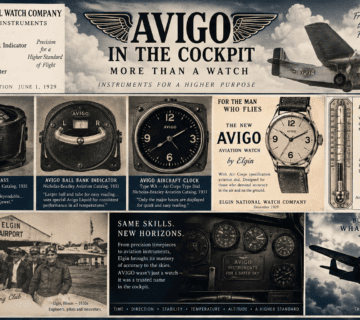
Among the surviving period material from the aftermath of the flight is an Elgin advertisement with a remarkable claim. The advertisement stated that the Hunter Brothers had recorded their precious hours using their Avigo Elgin Strap Watch.
That sentence gives AVIGO a very different place in aviation history than a modern marketing photograph could ever create. This was not a watch placed beside a restored aircraft decades later. Elgin was connecting AVIGO directly to men who had just completed one of the most extreme endurance flights of their era.
We should still be precise about what the historical evidence proves. The advertisement does not establish which brother wore the watch at every stage of the flight, and until an original Hunter Brothers AVIGO is located, there is no reason to invent a specific provenance. But the period advertisement itself establishes something important: Elgin publicly associated AVIGO with the Hunter Brothers and their record almost immediately after it happened.
That association fit the watch. AVIGO was being promoted during an era when aviation was changing almost monthly, when record flights were proving what aircraft could do and when America’s pilots were becoming some of the most recognizable adventurers in the country. The Hunter Brothers represented that world perfectly.
Twenty-Three Days in the Air
By July 4, the City of Chicago had been airborne for its twenty-third consecutive day. The brothers had already surpassed the old record by a wide margin, but the airplane was beginning to make the decision for them.
A clogged screen interfered with the engine’s oil supply. Kenneth attempted to remove it for cleaning, but oil began spraying out and the engine could no longer be trusted to continue indefinitely. TIME reported the episode only days later, noting that the brothers were finally forced to land with a new endurance record of 553 hours, 41 minutes and 30 seconds—more than 133 hours beyond the previous mark. Read TIME’s July 14, 1930 account of the Hunters’ landing
The FAI later ratified the achievement. John and Kenneth had remained continuously airborne from June 11 through July 4, supported by Albert and Walter in Big Ben, for a duration equivalent to flying approximately one and a half times around the world.
When the City of Chicago finally approached Sky Harbor, thousands of people were waiting. Surviving film shows the airplane passing over the field, touching down and taxiing as spectators rush across the grass toward it. The men who had spent more than three weeks above them were finally back on the ground. Watch the original footage of the Hunter Brothers landing on July 4, 1930
The Man Outside the Airplane
John Hunter helped keep the aircraft flying. Albert and Walter repeatedly brought the fuel and supplies without which the attempt could not have continued. Their mother and sister kept the operation moving from the ground. It was a true family effort, and every one of those roles deserves its own story.
But there is something unforgettable about Kenneth.
When a problem appeared that could not wait until landing, he did not have the luxury of calling a mechanic. He climbed out of the airplane and became one.
Early aviation was filled with men and women doing things for which no comfortable procedure yet existed. Machines were being pushed beyond what their designers had expected, endurance records were being broken only to be broken again, and the people inside those aircraft were discovering the limits of aviation by personally confronting them.
A watch did not make Kenneth Hunter courageous, and it did not keep the City of Chicago airborne for 553 hours. A watch can only measure the time while people decide what they are willing to do with it.
But somewhere in the historical record of those twenty-three days is the name AVIGO. Nearly a century later, that feels strangely appropriate.
Because when the airplane could not come down to the mechanic, Kenneth “Beans” Hunter went outside to meet it.

No comment