

Reconstructing a Forgotten American Aviation-Watch Line, One Survivor at a Time
For nearly a century, AVIGO has been easy to misunderstand. Find a single advertisement or surviving example and it is tempting to imagine that Elgin created one aviation wristwatch during America’s early fascination with flight, sold it for a short time, and then quietly moved on. The deeper the surviving material is examined, however, the less that explanation seems to fit.
What is emerging instead is a much more interesting picture. AVIGO appears to have been a genuine family of aviation-oriented wristwatches offered in different cases, metals, dial treatments, movement grades and price levels. The watches changed as American aviation itself changed, moving from the bold Art Deco excitement of the late 1920s and early 1930s toward the smoother, more aerodynamic design language of the middle of the decade.
The basic aviation identity remained recognizable. Large, rapidly legible numerals, strong dial contrast and an obvious connection with flight appear repeatedly. But the watches built around that idea were not all the same. Surviving examples and period material point to a broader collection, with different watches aimed at different buyers.
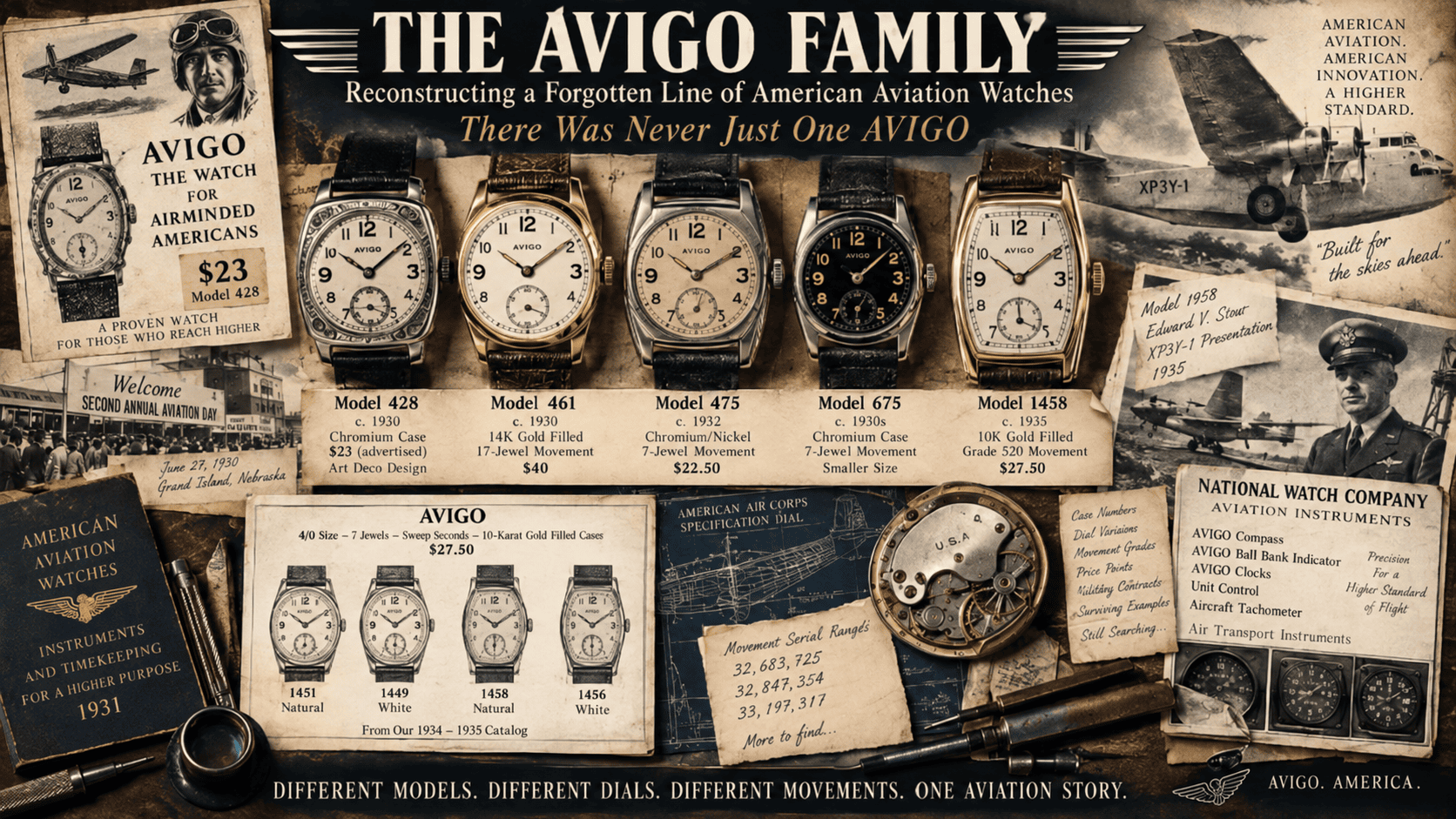
Five references in particular help show just how varied the AVIGO family became: Models 428, 461, 475, 675 and 1458.
One Catalog Page Changed the Question
One of the most important pieces of evidence appears in period catalog material preserved in the Edward V. Sizer research collection. Instead of showing one AVIGO, the catalog presents four related watches together: Models 1451, 1449, 1458 and 1456.
The watches are identified as 4/0-size, seven-jewel models with sweep seconds and 10-karat gold-filled cases, offered at $27.50. Different dial treatments are shown, and the 1458 and 1456 are specifically associated with AVIGO luminous dials.
That one catalog image changes the question completely. Rather than asking what “the AVIGO” looked like, the better question becomes how many configurations Elgin offered under the aviation concept.
The catalog group is only one part of the surviving evidence. Earlier and differently numbered AVIGOs show considerably greater variation in case style, material, movement and price. Taken together, the pieces begin to look less like scattered oddities and more like members of the same product family.
Model 428: AVIGO at Its Most Art Deco
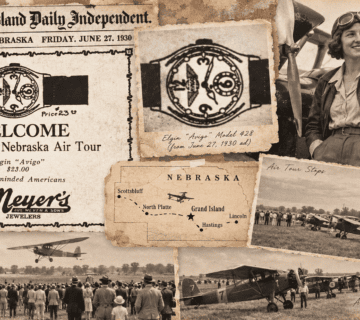
The Model 428 is one of the most visually distinctive AVIGOs known today. Its cushion-shaped case belongs unmistakably to the Art Deco era, and surviving examples have been documented with decorative wing-like treatment around the bezel.
The design captures the mood of early American aviation remarkably well. During this period, airplanes were not yet ordinary transportation. Flight represented technology, adventure and modernity, and the 428 wore that enthusiasm openly.
Surviving specialist documentation describes the watch with a chromium-nickel case and a seven-jewel Elgin Grade 485 manual-wind movement. Period documentation places this type of AVIGO in the low-$20 price range, making aviation styling available to a relatively broad group of buyers.
The Model 428 is particularly important because AVIGO advertising from this era did not merely place an airplane somewhere in the background. The watch was marketed directly toward an aviation-minded public.
See the documented Elgin AVIGO Model 428
The 428 looks like a watch created at a moment when simply being interested in aviation said something about the future a person believed was coming.
Model 461: A Higher-End AVIGO
The Model 461 reveals a different side of the line.
While less expensive AVIGOs could be offered in chromium cases with seven-jewel movements, surviving documentation describes the 461 with a 14-karat white-gold-filled case and a 17-jewel Elgin Grade 487 movement. Its reported period price was approximately $40, substantially more than the lower-priced AVIGO models.
That price difference is important. It suggests that AVIGO was not confined to a single price point. A customer interested in the aviation concept could choose a comparatively affordable watch, while another buyer could move into a gold-filled case with a higher-grade movement.
Yet the family resemblance remained. The aviation-style numerals, the AVIGO identity and the emphasis on legibility were still there.
See the documented Elgin AVIGO Model 461
The Model 461 helps turn AVIGO from an interesting specialty watch into something that looks much more like a structured product line. Elgin could preserve the aviation identity while changing the quality of the case and movement beneath it.
Model 475: Another Branch of the Family
The Model 475 returns to the more affordable end of the range, but it is not simply another 428.
Surviving documentation describes a cushion-style case using chromium-nickel and rolled-gold plating, along with the familiar large aviation numerals and a seven-jewel movement. A documented period price of approximately $22.50 places it close to the lower-cost AVIGOs of the era.
One surviving 475 is especially valuable to researchers because its dial has been described as factory-original new-old stock. That is extremely important when reconstructing a watch line that is nearly a century old.
Vintage watches are frequently refinished. Dials are repainted, luminous material is replaced, hands are changed and movements or cases sometimes become separated over the decades. A beautifully restored watch can therefore be misleading if later work is mistaken for original factory specification.
An untouched dial becomes a historical reference point.
See the documented Elgin AVIGO Model 475
The 475 reinforces the idea that AVIGO developed through overlapping variations rather than a simple sequence in which one watch was discontinued and replaced by another.
Model 675: Smaller, Darker and Still Clearly AVIGO
The Model 675 changes the character again.
Surviving documentation describes a smaller cushion-style case and a seven-jewel Grade 430 movement. Perhaps most striking is the darker aviation dial seen on surviving examples. Against that darker background, the large numerals create a very different visual personality from the lighter-dial AVIGOs.
Yet it still looks related.
See the documented Elgin AVIGO Model 675
Place the 675 beside the decorated 428, the higher-grade 461 and the later 1458 and the differences become impossible to ignore. They share a design vocabulary without being copies of one another.
That is precisely what makes the idea of an AVIGO family so compelling.
Model 1458: AVIGO Moves Into the Streamline Era
By the middle of the 1930s, the design language surrounding American transportation was changing. The harder geometry of Art Deco was increasingly giving way to the smoother, more aerodynamic forms that became known as Streamline Moderne.
The Model 1458 appears to belong to that transition.
Period catalog material shows the 1458 as part of the group that also included Models 1451, 1449 and 1456. The watches were identified as 4/0-size, seven-jewel models with sweep seconds and 10-karat gold-filled cases priced at $27.50.
The 1458 also occupies an especially important place in AVIGO history because it is connected with the surviving 1935 presentation watch belonging to Edward V. Sizer.
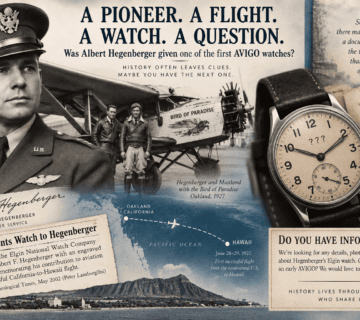
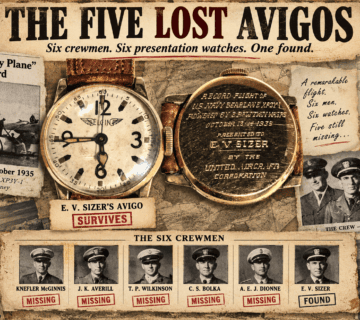
Sizer was one of the crewmen aboard the U.S. Navy’s experimental XP3Y-1 flying boat during its record-setting 1935 flight. His surviving gold AVIGO carries an engraved caseback commemorating that achievement, transforming the watch from a simple vintage object into a physical piece of aviation history.
Research and historical material surrounding Sizer’s watch have been preserved by watch collector and historian Robert Stokes of Time Capsule Watch, whose work has helped make this later chapter of the AVIGO story visible again.
Read the Edward V. Sizer AVIGO research at Time Capsule Watch
The 1458 therefore provides something the earlier models do not. It gives us a documented bridge between the AVIGO product family and an actual record-setting aviation event.
The Surviving Watches Make the Story More Complicated
As more AVIGOs are brought together, the family becomes easier to recognize but harder to completely explain.
Surviving examples appear with light dials and dark dials. Cases range from decorated cushion shapes to smoother streamlined forms. Some watches use seven-jewel movements while others contain higher-grade seventeen-jewel movements. Different metals and finishes appear, and prices vary considerably.
There are also additional references beyond the five highlighted here. Historical research has produced numbers such as 426, while surviving examples have raised questions about an E-302-related designation and other case or catalog numbering systems.
One surviving early AVIGO documented by Vintage Watch Restoration carries an original winged aviation-style dial and an Elgin-signed case associated with an E-302 designation.
View the surviving E-302-related AVIGO
Another surviving AVIGO uses a distinctive winged tonneau-style case, again showing how far the physical design could vary while retaining the recognizable aviation identity.
View the surviving winged-tonneau AVIGO
Those watches should not automatically be forced into a neat model chronology. The evidence is not complete enough yet.
The Numbers Do Not Yet Tell One Clean Story
The model numbers may eventually become one of the most revealing parts of the AVIGO story, but they are also one of the areas where caution matters most.
Period material gives us references such as 1449, 1451, 1456 and 1458. Other documented surviving watches carry numbers such as 428, 461, 475 and 675. Additional watches introduce still more designations.
Those numbers may represent different model systems, case references, catalog configurations or numbering practices used at different periods. Without the original factory documentation explaining exactly how the systems relate, it would be easy to turn assumptions into false history.
For now, the safest approach is to keep each number attached to the source that identifies it and allow additional catalogs and factory records to fill in the gaps.
A messy historical record is better than a neat one built on guesses.
The Movements Tell the Same Story
The mechanical evidence also argues against the idea of one standard AVIGO.
Surviving AVIGO-related examples have been documented with several movement grades, including 487, 485, 430 and the later 502.
That means AVIGO production cannot be estimated simply by finding the production number for one particular Elgin movement. The line crossed multiple movement grades, and those movements were not necessarily exclusive to AVIGO.
Movement serial numbers, case numbers, grades, dial layouts and surviving advertisements therefore need to be recorded together.
Every surviving watch is another piece of the family tree.
From Art Deco to Streamline Moderne
Perhaps the most fascinating thing about looking at AVIGO as a family rather than a single watch is watching the design change alongside aviation itself.
Around 1930, airplanes were surrounded by an Art Deco visual world of dramatic wings, sharp geometry and decorative forms. Aviation was still spectacle as much as transportation, and the earliest AVIGO watches reflect that excitement.
By the middle of the decade, aircraft, automobiles and locomotives were becoming smoother and more aerodynamic. Streamlining was becoming the visual language of speed.
The AVIGO watches seem to move in the same direction.
The bold aviation numerals remain recognizable, but the cases begin to look less architectural and more fluid. In only a few years, the design appears to have traveled from the age of the barnstormer toward the age of modern transportation.
The Family Album Is Still Incomplete
Models 428, 461, 475, 675 and 1458 give us five particularly useful members of the AVIGO family, but they should not be treated as the entire family.
The 428 shows AVIGO embracing dramatic Art Deco aviation styling. The 461 demonstrates that the concept could move upscale with a gold-filled case and seventeen-jewel movement. The 475 provides another affordable configuration and an important surviving dial reference. The 675 changes the scale, movement and dial appearance while retaining the aviation identity. The 1458 carries AVIGO into the middle of the 1930s and connects the line with Edward Sizer and the XP3Y-1 record flight.
Beyond those five, the catalog group containing 1451, 1449, 1458 and 1456 proves that still more configurations existed.
And there are almost certainly additional AVIGOs waiting to be identified.
Some may be sitting in collections described simply as “1930s Elgin pilot watch.” Others may have been refinished so heavily that their original appearance is difficult to recognize. A jeweler’s catalog sitting undigitized in an archive could contain a model number we have never seen. An estate watch may still carry a movement serial that helps establish another point in the chronology.
Nearly a century ago, these watches left the factory and scattered into collections, families and jewelry boxes across America. Today, old advertisements, catalogs, surviving watches and historical research are beginning to bring those pieces back together.
The story is no longer about discovering one forgotten AVIGO.
It is about rebuilding the AVIGO family.
Sources & Further Reading
AVIGO Watch-Line History
Elgin.Watch — AVIGO Watch Line
AVIGO Model 428
Elgin Wristwatches — Model 428
AVIGO Model 461
Elgin Wristwatches — Model 461
AVIGO Model 475
Elgin Wristwatches — Model 475
AVIGO Model 675
Elgin Wristwatches — Model 675
Edward V. Sizer and Model 1458
Robert Stokes / Time Capsule Watch — Edward V. Sizer AVIGO Research
Additional Surviving AVIGO Examples
Vintage Watch Restoration — E-302-Related AVIGO
Vintage Watch Restoration — Winged Tonneau AVIGO
Research Credit
This reconstruction draws from surviving AVIGO watches, period advertisements and catalogs, specialist watch documentation and the historical research material preserved around Edward V. Sizer’s AVIGO. Particular credit is due to Robert Stokes of Time Capsule Watch for preserving and documenting the Sizer watch and related AVIGO material that has helped open several new areas of research into the line.

No comment