
AVIGO Was Already in the Cockpit
Long Before It Became a Forgotten Wristwatch, AVIGO Was Helping Pilots Navigate the Sky
The most surprising discovery in the history of AVIGO did not come from an old watch catalog, a jeweler’s advertisement or the engraving on the back of a presentation watch. It came from the aviation industry itself.
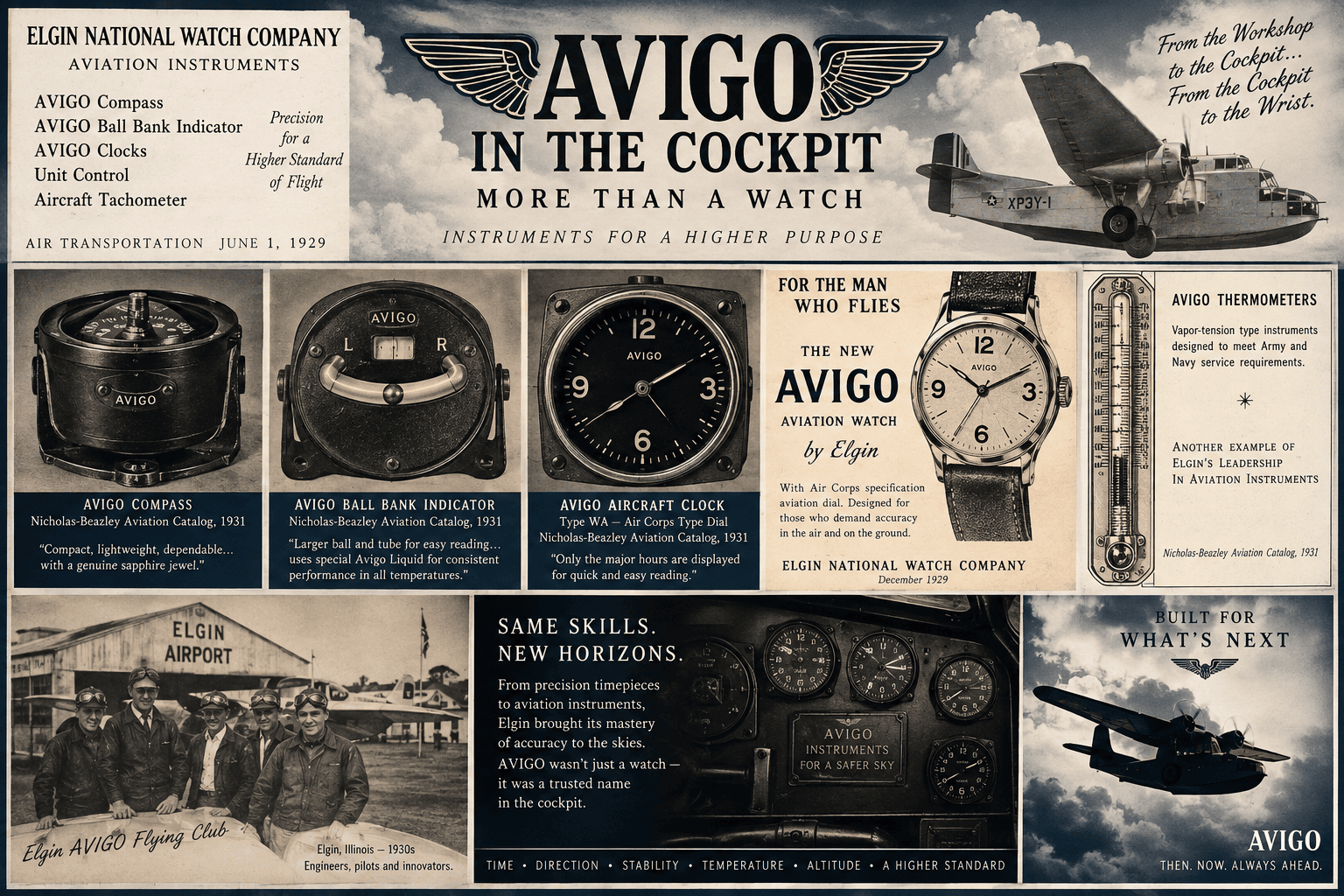
Buried inside a June 1929 aviation trade publication was a listing for the Elgin National Watch Company. The products associated with Elgin were not limited to watches. The listing included an AVIGO Compass, AVIGO Ball Bank Indicator and AVIGO Clocks, alongside other Elgin aviation equipment such as a unit control and aircraft tachometer.
That changes the AVIGO story considerably.
The name was not simply being attached to a wristwatch because airplanes happened to be fashionable. By 1929, AVIGO was already being used in connection with equipment intended to operate inside airplanes.
And once that becomes clear, the wristwatch begins to look very different.
Aviation Was Becoming an Instrument Business
Flying during the late 1920s was undergoing an enormous transformation. Pilots were flying farther, operating at night, crossing increasingly difficult weather and beginning to use airplanes as serious transportation rather than primarily as sporting machines or entertainment.
The cockpit had to evolve with them.
A pilot needed considerably more information than whether the engine was still running. Direction mattered. Engine speed mattered. Aircraft attitude, bank and slip mattered. Reliable time mattered.
Companies capable of producing delicate, precise mechanical watches suddenly found themselves operating in a world where many of those same manufacturing skills could be applied to instruments inside the cockpit.
The 1929 Aircraft Year Book provides particularly important evidence. It documents Elgin’s growing aircraft-instrument operation and refers to equipment known within the aviation trade as AVIGO instruments. The material connects Elgin with chronometric tachometers, AVIGO compasses and ball-bank indicators.
Read the 1929 Aircraft Year Book
That is a much stronger historical connection than simply placing an airplane in the background of a wristwatch advertisement. This was aviation-industry literature recognizing AVIGO in connection with aircraft equipment.
The AVIGO Compass Was More Than a Name on a Dial
By 1931, aviation catalogs were describing the AVIGO Compass in remarkable detail.
The instrument was designed to be compact and lightweight enough for aircraft use while still providing the reliability expected from a serious navigation instrument. The Nicholas-Beazley aviation catalog described a carefully hardened and polished pivot, a magnified viewing window, specialized damping oil and one particularly interesting detail: the pivot assembly used a genuine sapphire cup jewel.
That is a wonderfully revealing connection between watchmaking and aviation instrumentation.
Elgin was taking technology and manufacturing ideas familiar to precision watchmaking and applying them to an instrument whose purpose was not to tell a pilot when he would arrive, but to help determine whether the airplane was heading in the correct direction.
The catalog listed the AVIGO compass at approximately $50, more than twice the $23 price appearing in several contemporary AVIGO wristwatch advertisements.
Explore the 1931 Nicholas-Beazley Aviation Catalog
The wristwatch counted the minutes.
The compass helped make sure those minutes were taking the pilot where he intended to go.
Then There Was the AVIGO Ball Bank Indicator
The AVIGO Ball Bank Indicator sounds obscure today, but its job was important.
When an airplane turns, a pilot cannot always rely on physical sensation to determine whether that turn is properly coordinated. Acceleration and motion can make a slipping or skidding aircraft feel deceptively normal.
A ball-bank indicator provides a visual reference. The position of the ball helps the pilot recognize whether the airplane is moving cleanly through a turn or slipping sideways.
The 1931 Nicholas-Beazley catalog describes Elgin’s AVIGO version as using a larger-than-normal ball and tube to improve visibility in flight. Even the liquid inside the instrument received engineering attention. The catalog identifies it as “Avigo Liquid,” formulated so changes in temperature would have less effect on the instrument’s operation.
That tiny detail says something significant about what was happening behind the AVIGO name.
Somebody was thinking about what happened to a cockpit instrument as an airplane climbed from a warm airfield into colder air thousands of feet above the ground.
This was not aviation as decoration.
It was aviation as engineering.
See the AVIGO instrument specifications in the 1931 Nicholas-Beazley catalog
The AVIGO Clocks May Help Explain the Wristwatch
Perhaps the most intriguing part of the instrument story involves AVIGO clocks.
The June 1929 aviation-industry material explicitly lists AVIGO Clocks, and by 1931 aviation catalogs were offering an Elgin Type WA aircraft clock described as having an “air corps type” dial designed for rapid reading.
Now look at the classic AVIGO wristwatch.
Its visual signature is the dominance of 12, 3, 6 and 9. The major numerals immediately catch the eye while less important information is visually reduced.
Period Elgin advertising went even further, describing the AVIGO wristwatch as having an “Air Corps specification aviation dial.”
The design philosophy is difficult to miss. Reduce clutter. Emphasize the information a pilot needs. Make the dial readable quickly.
But this is also where we have to be careful with the history.
We have not yet located an original Air Corps technical specification proving that the AVIGO wristwatch dial was directly copied from a specific military aircraft-clock specification. What the evidence currently establishes is that Elgin was producing aviation instruments, that AVIGO clocks existed, that period aircraft clocks used highly legible major-hour layouts and that Elgin advertised the AVIGO wristwatch using Air Corps-specification language.
The connection is compelling.
It should not yet be presented as proven technical lineage.
That distinction matters.
AVIGO Kept Growing Beyond the Wrist
The deeper we go into aviation catalogs, the larger the AVIGO instrument family becomes.
By 1931, aviation literature was also documenting AVIGO thermometers, including versions described in connection with Army and Navy service requirements. Elgin was producing tachometers and other aircraft instrumentation during the same general period.
There is an important rule we are following as this history is reconstructed: not every Elgin aircraft instrument should automatically be called an AVIGO.
Some historical sources explicitly use the AVIGO name. We can document AVIGO compasses, ball-bank indicators, clocks and thermometers.
Other pieces of aviation equipment are identified simply as Elgin products.
There is no reason to blur that distinction. The documented story is already remarkable enough without claiming more than the surviving evidence supports.
The Men Building the Instruments Were Living Aviation Too
Then the research leads back to Elgin, Illinois.
During the same period in which AVIGO instruments were becoming part of the aviation business, the city of Elgin was trying to establish a modern airport.
Historical accounts of Elgin’s early airport identify Victor E. Showalter, an engineer associated with Elgin’s instrument division, as responsible for much of the planning required to obtain government approval for the field.
The same history specifically notes that the Elgin National Watch Company was then producing tachometers and the AVIGO magnetic compass and was a major contributor to the airport project.
Then comes one of those historical details that almost sounds too perfect.
Victor Showalter was also an active member of the Elgin AVIGO Flying Club.
Read the history of Elgin’s first airport and the AVIGO Flying Club
Suddenly the people behind the instruments become much easier to picture.
These were not simply watch-company employees sitting in an office and watching the aviation boom from a distance. At least some of the people surrounding the aircraft-instrument operation were participating in aviation themselves.
Showalter was involved in planning an airport while belonging to a flying club carrying the AVIGO name.
The Elgin History Museum’s historical index also preserves references to the AVIGO Flying Club, providing another trail for future research into its members, aircraft and activities.
Explore the Elgin History Museum’s historical index
Suddenly the AVIGO Wristwatch Makes More Sense
Put all of these pieces together and the original AVIGO wristwatch no longer looks like an ordinary watch onto which somebody pasted an aviation theme.
It begins to look like one part of a larger aviation program.
The AVIGO name was appearing on wristwatches, but it was also appearing on compasses, ball-bank indicators and clocks. Elgin was advertising an aviation-specification wristwatch while simultaneously operating inside the aircraft-instrument business. People associated with that operation were involved in airport development and, in Showalter’s case, participating in an AVIGO Flying Club.
None of this proves that every AVIGO wristwatch was carried into an airplane.
It proves something more important.
AVIGO’s aviation identity was not invented later. It was already there.
Now We Need to Find the Instruments
That discovery opens an entirely new historical search.
Where are the surviving AVIGO cockpit instruments?
The old industry material tells us they were made. Aviation catalogs describe their construction. Specifications and prices survive. It seems entirely possible that some of the instruments themselves survived as well.
An AVIGO compass could be sitting in a restored aircraft with nobody realizing the importance of the name on its face. A ball-bank indicator could be lying in a box of unidentified vintage gauges. An AVIGO clock could be cataloged by a museum simply as an old aircraft clock. A collector might own one and never make the connection to the wristwatch.
That means reconstructing AVIGO history can no longer remain only a watch-collector project.
The search has to extend into aviation museums, aircraft restorations, military archives, instrument collections, early-aircraft parts dealers and family collections connected to the people who worked around the industry.
And that may be the most exciting part of this discovery.
For nearly a century, AVIGO has mostly been remembered as an unusual American wristwatch from the golden age of aviation.
The evidence now suggests that description is far too small.
AVIGO was not merely inspired by the cockpit.
AVIGO was already in it.
Sources & Further Reading
1929 Aircraft Year Book
Documents the growth of Elgin’s aviation-instrument activity and equipment associated with the AVIGO name.
1929 Aircraft Year Book — American Aviation Historical Society archive
1931 Nicholas-Beazley Airplane Company Catalog
Contains period descriptions of the AVIGO Compass and other AVIGO aviation instrumentation, including technical construction details.
Nicholas-Beazley Aviation Catalog, 1931
Elgin’s Early Airport and the AVIGO Flying Club
Documents Elgin National Watch Company’s involvement in the airport project, its production of tachometers and the AVIGO magnetic compass, Victor Showalter’s role in planning, and his membership in the AVIGO Flying Club.
The First Elgin Illinois Airport — Digital Research Library of Illinois History Journal
Elgin History Museum
The museum’s Crackerbarrel historical index provides another research trail concerning the AVIGO Flying Club.
Elgin History Museum — Crackerbarrel Historical Index
Primary 1929 AVIGO Instrument Evidence
The June 1, 1929 Air Transportation trade material reproduced in the Edward V. Sizer research compilation lists AVIGO Compass, AVIGO Ball Bank Indicator and AVIGO Clocks among Elgin’s aviation products.
Edward V. Sizer / AVIGO Historical Research File
Research Note
The period evidence directly supports use of the AVIGO name on aviation instruments. The broader catalog record supports AVIGO compasses, ball-bank indicators, clocks and thermometers. The proposed direct technical relationship between the wristwatch’s 12-3-6-9 layout and a particular U.S. Air Corps aircraft-clock specification remains an open research question and should not be presented as established fact until the original technical specification is located.

No comment