Six Men Crossed America in a Navy “Mystery Plane.” Six Watches Were Presented. Only One Has Been Found.
In October 1935, six United States Navy airmen climbed aboard an experimental flying boat in the Panama Canal Zone and pointed it toward California. There would be no fuel stop and no intermediate landing. Unlike many of the spectacular aviation record attempts of the 1920s and 1930s, there was surprisingly little public attention while the men were actually attempting it.
Their aircraft was the Consolidated XP3Y-1, an experimental patrol flying boat being pushed far beyond an ordinary test flight. It was the prototype of an aircraft family that would soon become famous throughout the world as the PBY Catalina, one of the most recognizable flying boats of World War II.
The men aboard were doing more than simply transporting a new airplane across the country. They were helping the Navy determine what the next generation of long-range American naval aviation could accomplish. More than thirty-four hours after leaving the Canal Zone, the XP3Y-1 reached Alameda, California, after traveling approximately 3,281 miles nonstop and establishing a new international distance record for its class.
The airplane, the record and much of the crew’s story remain documented today. But another part of that flight’s history nearly disappeared.
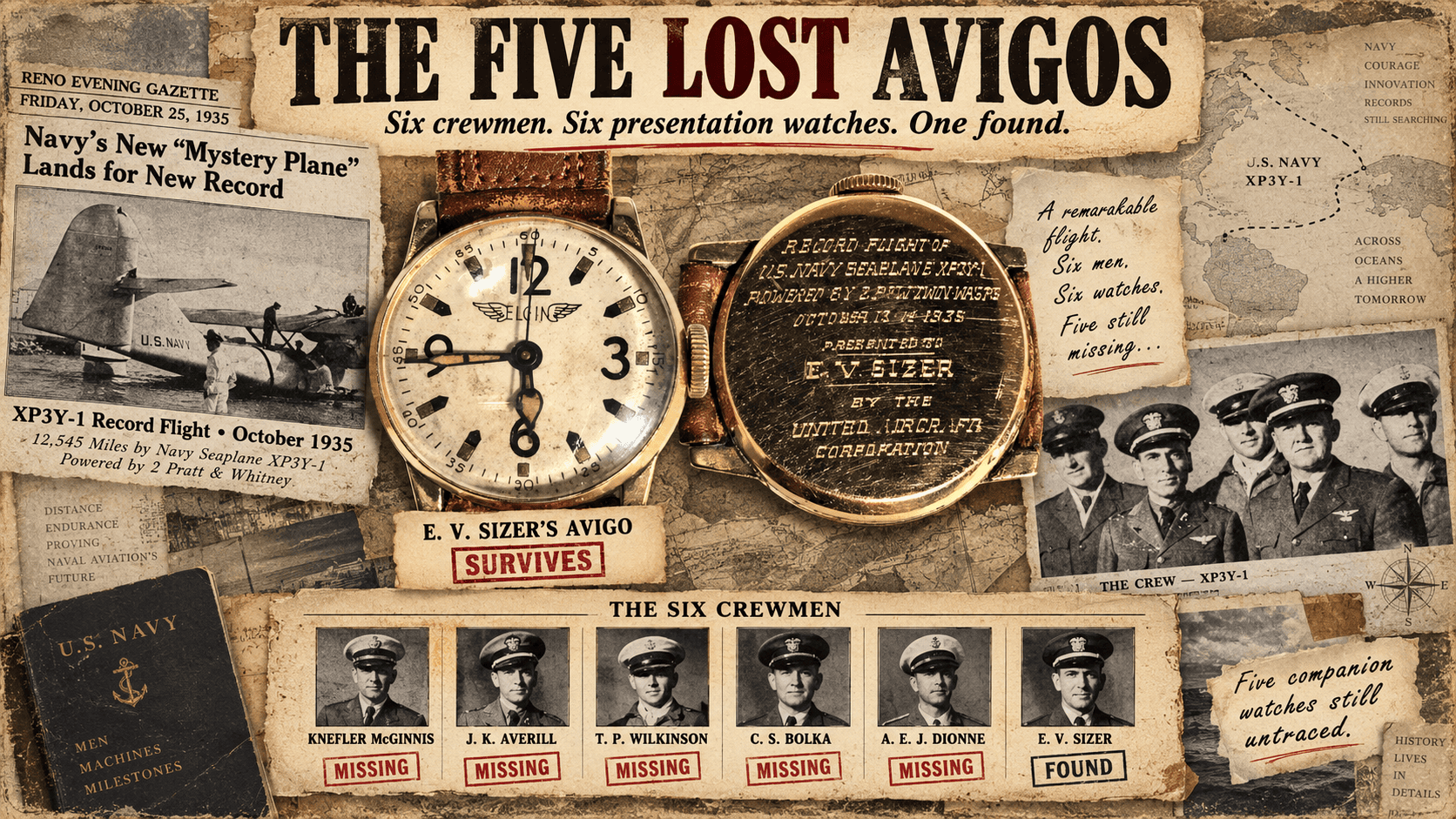
Historical research surrounding one surviving AVIGO wristwatch states that United Aircraft Corporation presented a specially engraved AVIGO to each of the six men aboard the XP3Y-1 in recognition of the flight. If that documentation is correct, six presentation watches were created.
Today, only one of them has been documented.
The other five remain unlocated.
The Watch That Survived
The one surviving watch that gives us a starting point belonged to Edward V. Sizer, one of the radiomen aboard the XP3Y-1.
Sizer’s AVIGO is remarkable because the engraving on its caseback transforms the watch into a physical historical document. The inscription identifies the record flight of the U.S. Navy seaplane XP3Y-1, references its two Pratt & Whitney Twin Wasp engines, names Sizer as the recipient and identifies United Aircraft Corporation as the presenter.
The historical research documents Sizer’s watch as a 10-karat gold AVIGO Model 1458 with its original presentation engraving. This makes the connection unusually strong. The watch is tied to a specific crewman, a specific experimental aircraft and a specific record-setting flight.
More importantly, Sizer’s surviving example may provide the blueprint for identifying the five companion watches.
If each member of the six-man crew received a similarly engraved AVIGO, the other examples may carry substantially the same wording commemorating the XP3Y-1 flight, with only the recipient’s name changed. Those five names are Knefler McGinnis, James K. Averill, Thomas P. Wilkinson, C. S. Bolka and A. E. J. Dionne.
One of those watches could already be sitting in a private collection, an estate box or a family drawer whose owner has never understood the significance of the engraving.
View the Edward V. Sizer / AVIGO historical research file
The Flight Was About More Than Breaking a Record
Knefler McGinnis later explained that the XP3Y-1 mission was not created simply to chase a newspaper headline.
In an oral history preserved by the U.S. Naval Institute, McGinnis recalled that Admiral Ernest J. King, then Chief of the Navy’s Bureau of Aeronautics, wanted the experimental aircraft thoroughly proven. McGinnis was asked to command the flight, select the crew and help prepare the airplane for the mission.
The XP3Y-1 first flew from Norfolk to the Panama Canal Zone. After stopping there, the crew departed for the long nonstop leg to Alameda. McGinnis remembered the record portion of the journey as approximately 3,281 miles completed in 34 hours and 45 minutes.
His recollections are especially important because he also identified the men aboard. Alongside McGinnis were Lieutenant Junior Grade James K. Averill, Naval Aviation Pilot Thomas P. Wilkinson, Chief Machinist’s Mate C. S. Bolka, and radiomen A. E. J. Dionne and Edward V. Sizer.
Those are the same six names that matter to the AVIGO investigation.
Read Knefler McGinnis’s U.S. Naval Institute oral history
Official Navy aviation history also documents the XP3Y-1’s extraordinary nonstop flight and its importance in the development of American naval aviation.
Read the U.S. Navy’s history of the 1935 XP3Y-1 flight
A Mystery Hidden in the Dates
One particularly interesting detail appears when Sizer’s surviving watch is compared with the Navy’s official chronology.
The engraving on the watch gives the flight dates as October 13–14, 1935, while Navy historical records place the Canal Zone-to-Alameda portion of the flight on October 14–15, 1935.
That discrepancy should not simply be corrected or ignored. The watch itself is a historical artifact, and its engraving records what United Aircraft Corporation chose to place on the presentation piece. The Navy chronology records the flight according to official historical documentation.
The difference could even become useful if another watch surfaces. If a second XP3Y-1 AVIGO carries the same October 13–14 dates as Sizer’s example, that matching detail may help establish that both watches were engraved together as part of the same presentation group.
Nearly Thirty-Five Hours in an Experimental Flying Boat
Flying more than 3,000 miles nonstop in 1935 required far more than simply keeping an airplane pointed toward California.
McGinnis later recalled that he, Averill and Wilkinson rotated through the pilot’s position, generally taking turns of roughly one hour. While one pilot rested in a bunk farther back in the aircraft, the others remained forward. That arrangement allowed the men brief opportunities to sleep before returning to the controls.
The XP3Y-1 even carried an early automatic pilot, an advanced feature for the period. McGinnis remembered that the system had developed trouble during the earlier Norfolk-to-Panama portion of the journey when glycerin leaked from its lines. It was repaired before the record leg and helped reduce some of the enormous physical burden placed on the pilots.
But the pilots were only part of the story. The two Pratt & Whitney Twin Wasp engines had to keep operating hour after hour. Communications had to remain open. Navigation had to remain accurate. The aircraft had to remain mechanically healthy while crossing thousands of miles with very few options if something failed.
That is what makes the six AVIGO presentations so fascinating. Although the watches may have been presented together, each belonged to a man performing a different job aboard the aircraft.
Knefler McGinnis — The Commander
Of the five men whose presentation watches remain unlocated, Knefler McGinnis left the deepest archival trail.
He was already an experienced naval aviator when selected to command the XP3Y-1. His career stretched across some of the formative decades of American naval aviation, and his personal papers are preserved today by the San Diego Air & Space Museum.
The collection includes photographs, correspondence, military orders, newspaper clippings and other material documenting his career. It also preserves evidence of his involvement in the 1935 record flight and the Distinguished Flying Cross he received for the achievement.
McGinnis continued his Navy career through World War II. Somewhere during those years, an engraved AVIGO bearing his name may have remained among his personal possessions.
What happened to it afterward is unknown. It may have remained with his family, passed through an estate or entered the watch and military-collectibles market decades later without anyone recognizing its importance.
Explore the Knefler McGinnis Personal Papers at the San Diego Air & Space Museum
James K. Averill — From Record Flight to War
James Kent Averill followed a very different path.
Averill graduated from the United States Naval Academy in 1927 and became a naval aviator. By the time of the XP3Y-1 flight in 1935, he was serving as a lieutenant junior grade and was one of the three pilots rotating through the controls during the record journey.
His naval career continued long after the headlines surrounding the experimental flying boat faded.
By World War II, Averill had risen to commander and was serving in the Pacific. On March 26, 1944, he was killed when the aircraft aboard which he was traveling crashed shortly after taking off from the aircraft carrier USS Lexington. He was serving as Chief of Staff for Carrier Division 11 and was returning to USS Yorktown.
His wartime death creates an obvious question for anyone trying to trace his missing AVIGO. If Averill still owned the watch in 1944, it may have remained at home while he served overseas. It could have passed to his family after his death and remained there for decades, or it could eventually have entered an estate sale with no surviving explanation of why the watch carried an unusual aviation engraving.
The answer is unknown, but the search has one major advantage: we know the name that should appear on the back.
Read the U.S. Naval Academy Virtual Memorial Hall biography of James K. Averill
Thomas P. Wilkinson — The Third Pilot
Thomas P. Wilkinson was the third pilot rotating through the controls of the XP3Y-1.
Official Navy history identifies him as a Naval Aviation Pilot, while McGinnis’s own recollections place Wilkinson directly in the rotation with McGinnis and Averill during the long journey to California.
For approximately thirty-five hours, those three aviators shared responsibility for keeping an experimental flying boat moving toward its destination.
The readily available public record for Wilkinson is considerably thinner than the material surviving for McGinnis and Averill. That is exactly where historical research has to remain careful. A lack of information should not be filled with assumptions simply to make the story feel more complete.
What we can establish is important enough. Wilkinson was one of the men actually flying the XP3Y-1 on its record-setting journey. If the six-watch presentation record is correct, an AVIGO engraved for T. P. Wilkinson should once have existed.
Whether that watch survives today remains unknown.
C. S. Bolka — Keeping the Machine Alive
Stories about record flights naturally focus on the men holding the controls, but an aircraft cannot remain in the air for nearly thirty-five hours on pilots alone.
C. S. Bolka served as the XP3Y-1’s Chief Machinist’s Mate.
That role becomes much more significant when considered in the context of the flight. The experimental aircraft’s two Pratt & Whitney Twin Wasp engines had to operate hour after hour while the flying boat crossed thousands of miles.
There was no scheduled maintenance stop along the way and no nearby airport waiting if a mechanical problem developed. The machine simply had to keep running.
McGinnis specifically remembered Bolka as a member of the six-man crew, yet Bolka’s personal history remains one of the less developed areas of the surviving record.
That could make his missing AVIGO particularly significant. An engraved object can sometimes do more than commemorate a famous event. It can help restore a less-remembered participant to the historical record.
If an AVIGO engraved C. S. Bolka survives, that watch could become one of the strongest physical links remaining to the machinist who helped keep the XP3Y-1 in the air during its record flight.
A. E. J. Dionne — The Other Radioman
Edward Sizer was not the only radioman aboard the flying boat.
McGinnis’s account identifies another radioman named Dionne, and the surviving AVIGO research records him as A. E. J. Dionne.
Like Bolka, Dionne is more difficult to reconstruct from readily available historical sources. Rather than filling those gaps with speculation, the missing details become questions for future research.
What was Dionne’s naval career before and after the XP3Y-1 flight? Where did he live later in life? Did he have descendants? Were his military and personal possessions preserved by his family?
Most importantly for the AVIGO search, did an engraved watch commemorating the record flight remain among those possessions?
We may not yet know where the watch is, but we do know the name that should appear on it.
A Six-Watch Presentation, Not Just One Remarkable Watch
Edward Sizer’s surviving AVIGO is extraordinary by itself, but the research surrounding it suggests that it was originally part of something larger: a six-watch presentation group.
The crew consisted of Knefler McGinnis as commander and pilot, James K. Averill and Thomas P. Wilkinson as pilots, C. S. Bolka as Chief Machinist’s Mate, and A. E. J. Dionne and Edward V. Sizer as radiomen.
Sizer’s presentation watch has survived with its inscription intact. The other five have not yet been located.
One point is especially important. Although Sizer’s surviving watch is documented as an AVIGO Model 1458, there is not yet independent documentation proving that all six men received exactly the same model or configuration.
It would be easy to assume they did, but that would turn an unanswered question into a false certainty. Until another watch or additional presentation document appears, the exact cases, dials and movements of the other five watches should remain unresolved.
What Would a Lost AVIGO Look Like?
Imagine an old gold AVIGO appearing at an estate sale, watch show, auction house or online listing.
From the front, there might be nothing obvious connecting it to one of the most important experimental naval flights of the 1930s. It might simply appear to be an unusual vintage aviation wristwatch.
Then someone turns it over.
The caseback carries an inscription mentioning the Record Flight of U.S. Navy Seaplane XP3Y-1, the Pratt & Whitney Twin Wasp engines and the October 1935 flight. Beneath that inscription appears the name McGinnis, Averill, Wilkinson, Bolka or Dionne.
At that moment, the watch would become something entirely different.
It could be the second documented member of the XP3Y-1 AVIGO presentation group.
A second surviving watch would also allow researchers to compare things that cannot be established from Sizer’s example alone. Case references, movements, gold content, engraving typography, dial configurations and production details could finally be compared side by side.
One surviving watch gives us an extraordinary story. A second could begin reconstructing the set.
The Navy’s “Mystery Plane”
Period newspaper accounts sometimes referred to the XP3Y-1 as the Navy’s new “Mystery Plane.”
McGinnis later explained that the aircraft was not technically secret. The Navy simply was not advertising everything it was doing with the experimental design.
That makes sense considering the growing strategic importance of long-range patrol aircraft. The Navy wanted to know how far a new generation of flying boats could travel and how reliably they could operate across enormous distances.
Naval History and Heritage Command records show that Navy ships were positioned along portions of the projected route. The destroyer USS Aylwin, for example, was assigned a plane-guard position off Guatemala and laid smoke as a visual marker before the XP3Y-1 passed overhead.
Read the Naval History and Heritage Command history involving USS Aylwin and the XP3Y-1
Once the XP3Y-1 reached California, the public quickly learned what had been accomplished. TIME covered the experimental aircraft only days later, reporting on the enormous flying boat and the new distance record it had established.
Read TIME’s October 1935 account of the XP3Y-1
From the XP3Y-1 to the PBY Catalina
The experimental aircraft would not remain experimental for long.
McGinnis later described the XP3Y-1 as the direct forerunner of the PBY series, connecting the 1935 record flight with an aircraft that would become one of the most recognizable flying boats of World War II.
The PBY Catalina would eventually perform maritime patrol, reconnaissance, anti-submarine operations and search-and-rescue missions across vast stretches of ocean.
That gives the AVIGO presentation story an unusual historical dimension. These watches were not merely prizes for winning an air race or promotional gifts handed to famous pilots. They commemorated the crew of an experimental airplane being pushed to demonstrate a long-range capability that would soon become enormously important to American naval aviation.
Somewhere, Five AVIGOs May Still Be Waiting
More than ninety years have passed since the XP3Y-1 arrived in California, yet remarkable pieces of its story remain.
McGinnis’s papers survived. Averill’s naval record survived. Navy documents survived. Photographs survived. The aircraft’s achievement survived.
And Edward Sizer’s AVIGO survived.
There is no reason to automatically assume that all five of the remaining presentation watches were destroyed. They may have passed through families for generations. They may have disappeared into estate boxes or jewelry drawers. They may have been sold decades ago as ordinary old watches. One could already be sitting in a private collection whose owner has never researched the inscription.
That is why this story remains open.
We know the airplane, the record and the names of the six men aboard. We know what one presentation watch looks like and what its engraving says. According to the surviving historical research, five companion AVIGOs were once out there.
They may still be.
The next chapter of this story could begin when somebody turns over an old AVIGO and reads the name engraved on the back.
Sources & Further Reading
Edward V. Sizer / XP3Y-1 AVIGO Research
The surviving Sizer watch and its associated historical research provide the primary evidence currently connecting an AVIGO presentation watch with the XP3Y-1 crew.
Edward V. Sizer — 1935 AVIGO Research File
Captain Knefler McGinnis Oral History
McGinnis’s recollections provide an important first-person account of the aircraft, flight, crew and purpose of the XP3Y-1 mission.
U.S. Naval Institute — The Early Years of Naval Aviation Remembered
Official U.S. Navy Aviation History
Naval History and Heritage Command — Naval Aviation, 1930–1939
Knefler McGinnis Archive
San Diego Air & Space Museum — Capt. Knefler McGinnis Personal Papers
James K. Averill
U.S. Naval Academy Virtual Memorial Hall — Commander James K. Averill
XP3Y-1 Route and Plane-Guard Operations
Naval History and Heritage Command — USS Aylwin
Contemporary 1935 Coverage
TIME — “Transport: XP3Y-1,” October 28, 1935
Research Status
The surviving Edward V. Sizer AVIGO provides physical evidence of Sizer’s presentation watch. Historical research accompanying that watch states that United Aircraft Corporation presented engraved AVIGOs to all six XP3Y-1 crew members. McGinnis’s oral history independently identifies the crew as McGinnis, Averill, Wilkinson, Bolka, Dionne and Sizer.
Read McGinnis’s original Naval Aviation memoir transcript
The AVIGOs associated with Knefler McGinnis, James K. Averill, Thomas P. Wilkinson, C. S. Bolka and A. E. J. Dionne have not yet been located. Until another watch or independent presentation record surfaces, their exact model, configuration and present whereabouts remain open historical questions.


No comment