

A Gold Elgin Avigo, a Secretive Navy Seaplane and a 34-Hour Flight Into History
Lt. Edward V. Sizer’s 1935 presentation watch connects one of Elgin’s most important aviation models to a record-setting U.S. Navy flight and the aircraft that would become the legendary PBY Catalina.
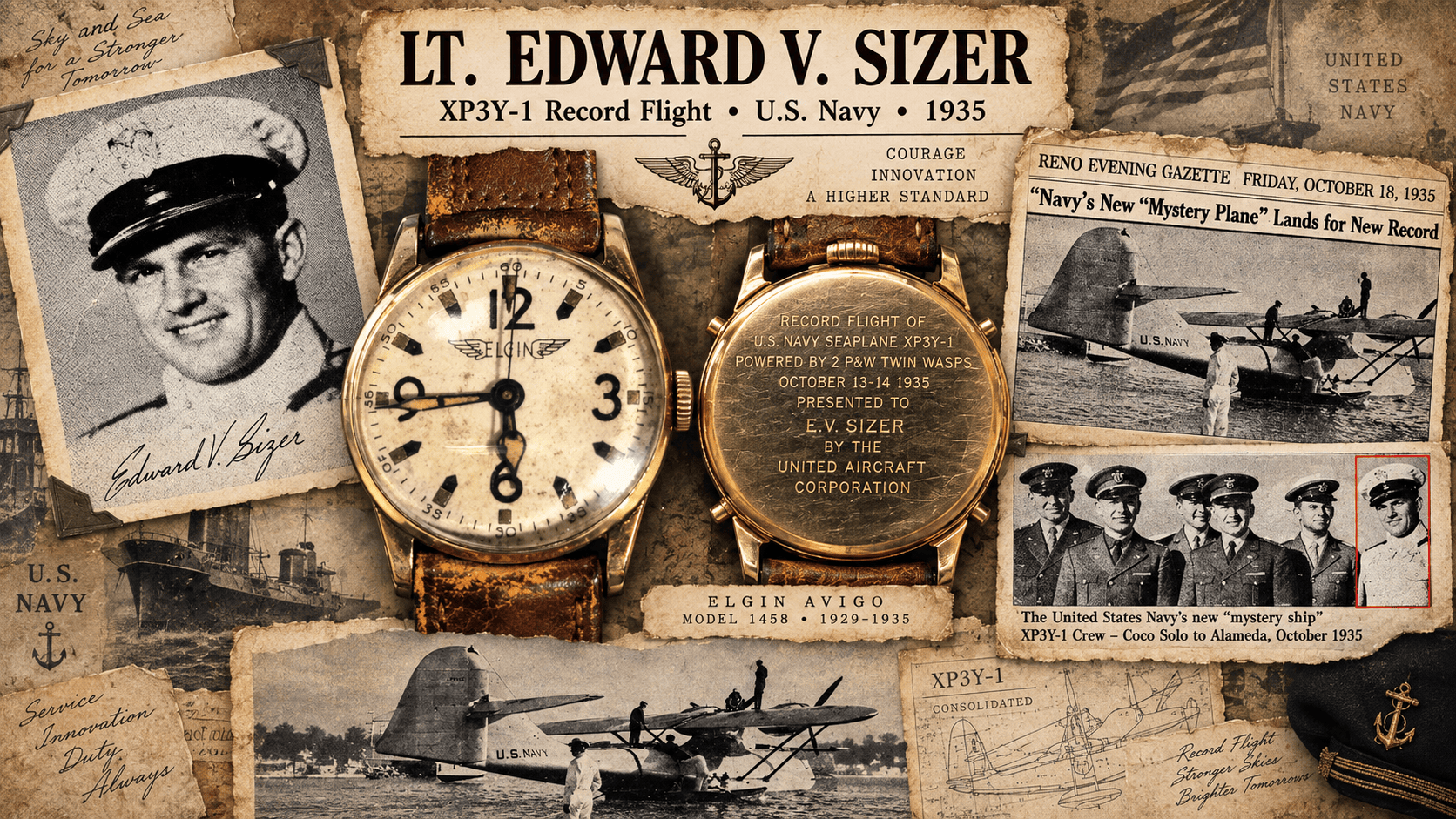
In October 1935, six U.S. Navy crewmen climbed aboard an experimental flying boat in the Panama Canal Zone and pointed it toward California. Nearly 35 hours later, they arrived in Alameda after flying roughly 3,387 miles nonstop, setting a new long-distance mark for their class of seaplane. One of the men aboard was Navy radioman Edward Vernon Sizer, and the small gold Elgin wristwatch later presented to him for that achievement survives as an extraordinary link between American watchmaking and the early days of long-range naval aviation.
The watch is an Elgin Avigo Model 1458, a late example of the aviation-inspired line Elgin introduced during the explosion of American enthusiasm for flight in the late 1920s and early 1930s. Yet Sizer’s example is far more than a rare vintage watch. Its engraved caseback ties it directly to a specific aircraft, a specific crewman and one of the most important developmental flights in U.S. naval aviation.
Much of what is known today about Sizer’s watch, its provenance and the man who wore it has been preserved through the research of Robert Stokes of Time Capsule Watch. Stokes has assembled photographs, period newspaper clippings, military records, watch documentation and historical material tracing both Sizer’s career and the watch’s connection to the 1935 flight. His research forms the foundation of this story. Time Capsule Watch
The Navy’s Experimental “Mystery Plane”
The aircraft at the center of the story was the Consolidated XP3Y-1, an experimental U.S. Navy patrol flying boat built to test a new generation of long-range maritime aircraft. At the time, it was cutting-edge technology. In hindsight, its importance is even greater: the XP3Y-1 was the developmental predecessor of the PBY Catalina, which would become one of the most famous American flying boats of World War II.
The flight from Coco Solo, Panama, to Alameda, California, became national news. Newspapers described the Navy seaplane as a new or even “mystery” aircraft as reports spread across the country about the record-setting journey. The crew had remained in the air for roughly 34 hours, covering thousands of miles in a machine that was still essentially an experimental prototype.
Years later, flight commander Knefler McGinnis recalled the mission and named the crew. Among them were two radiomen: E. J. Dionne and E. V. Sizer. McGinnis remembered the flight lasting approximately 34 hours and 45 minutes nonstop.
That detail matters because Sizer’s job was far from ceremonial. Long-distance flight in 1935 depended heavily on radio communication, and the crew was operating in an era before satellite navigation, modern weather radar or the sophisticated avionics pilots rely on today. Sizer was part of the technical backbone that made such a flight possible.
A Watch Presented for the Achievement
After the record flight, the United Aircraft Corporation commemorated the achievement by presenting specially engraved Elgin watches to members of the crew. Sizer’s surviving watch carries a remarkably detailed inscription recording exactly why it was given.
The caseback identifies the “Record Flight of U.S. Navy Seaplane XP3Y-1,” notes that the aircraft was powered by two Pratt & Whitney Twin Wasp engines, records the dates October 13–14, 1935, names E. V. Sizer, and identifies the United Aircraft Corporation as the presenter.
For a collector, that is the sort of provenance that changes everything. There is no need to reconstruct the story from vague family tradition or an anonymous engraving added decades later. The watch itself records the event.
That is what makes Sizer’s Avigo so compelling. It is simultaneously a watch, an award and a historical document.
The Elgin Avigo Model 1458
The Avigo name had already been associated with aviation for several years by the time Sizer received his watch. Elgin introduced the line during the aviation boom that followed Charles Lindbergh’s 1927 Atlantic crossing, the expansion of airmail and the rapid growth of commercial and private flying.
Avigo watches were known for their highly legible dials, particularly the oversized 12, 3, 6 and 9 numerals that gave the watch a distinctly aviation-oriented appearance. Research material in the Sizer archive documents multiple Avigo dial designs sold between roughly 1929 and 1935.
The Model 1458 came near the end of that original run. Period catalog material identifies it as a 7-jewel, 4/0-size watch with a 10-karat yellow-gold-filled case, luminous aviation-style dial and sweep seconds hand. It was priced at $27.50 in 1935.
The 1458 is also visually interesting because it differs from many earlier Avigo watches. Rather than prominently displaying the word AVIGO within the familiar winged emblem, the dial uses a winged Elgin signature while retaining the bold 12-3-6-9 layout that had become associated with the Avigo family.
Sizer’s example is especially important because Stokes’ documentation describes the watch as remarkably original, including its dial and leather strap.
From Record Flight to the Atomic Age
Sizer’s story did not end when the XP3Y-1 touched down in California. His career continued through some of the most dramatic technological changes of the 20th century.
He spent decades in the Navy working in radio, electronics and radar, later receiving a commission during World War II. By 1946, his expertise had taken him into another historic American undertaking: Operation Crossroads, the atomic bomb tests conducted at Bikini Atoll.
Documentation collected in the research identifies Lt. E. V. Sizer as a Bureau of Aeronautics liaison officer for airborne electronics equipment, involved in organizing and executing electronics work connected with the operation.
After retiring from the Navy in the early 1950s, Sizer continued working in advanced electronics with Raytheon for approximately another decade. He died in 1993 at the age of 88.
It is difficult to imagine a better object through which to tell his story than the watch that survived him.
A Small Watch With a Very Big Story
At roughly 30 millimeters across, Sizer’s Elgin Avigo is tiny by modern standards. Historically, however, it carries enormous weight.
It connects Elgin’s original aviation-watch heritage to a documented Navy aviator, Pratt & Whitney engines, the United Aircraft Corporation, an experimental aircraft and a flight that helped demonstrate the possibilities of long-range naval aviation.
Most importantly, it connects all of those larger stories to one individual.
Edward Sizer was there.
He served aboard the aircraft.
He helped complete the flight.
And the watch was presented to him because of it.
Nearly a century later, that small gold Avigo still carries the record on its back.
Research Credit
This article is based heavily on the historical research, photographs, provenance documentation and archival material assembled by Robert Stokes of Time Capsule Watch. His work preserving the history of Lt. Edward V. Sizer and the surviving 1935 Elgin Avigo Model 1458 made it possible to tell this story in detail.


No comment