

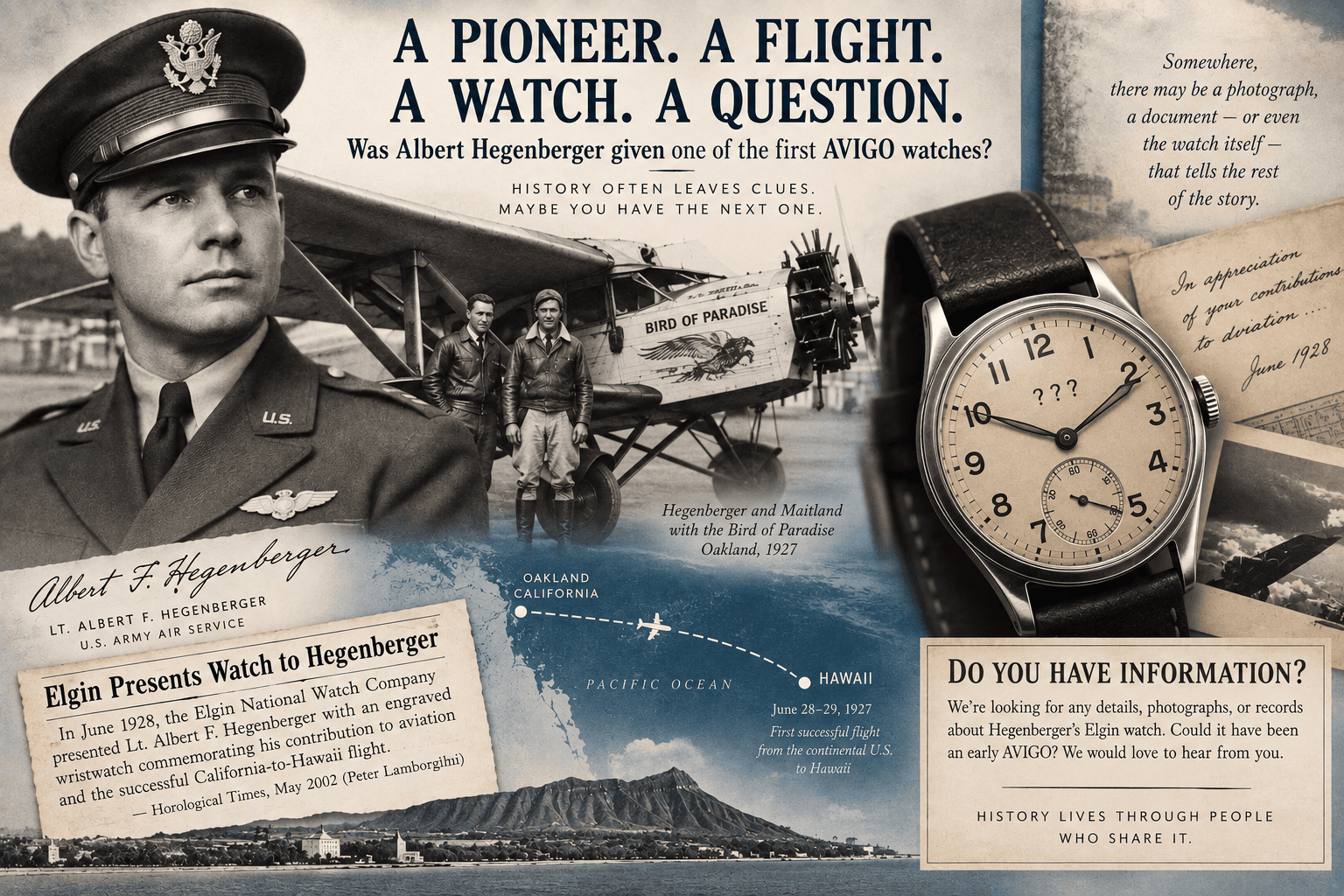
Could It Have Been One of the Earliest AVIGO Watches?
In the summer of 1927, two young Army aviators climbed aboard a three-engine Fokker named the Bird of Paradise and pointed its nose west from Oakland, California. Ahead of them was more than 2,400 miles of Pacific Ocean—and, unlike Charles Lindbergh’s flight to Europe a month earlier, there was no enormous continent waiting on the other side.
There were only islands.
The pilot was Lieutenant Lester J. Maitland. Beside him was Lieutenant Albert F. Hegenberger, an aeronautical engineer and navigator who had spent years helping develop the instruments and techniques that might someday make long-distance aviation practical.
Their flight would earn them a place in aviation history. It would also lead, one year later, to a mysterious presentation from the Elgin National Watch Company—a watch that may have a connection to the earliest days of AVIGO.
Nobody we have found can yet tell us exactly what that watch was.
And that is what we are trying to solve.
Flying Into the Pacific
On the morning of June 28, 1927, Maitland and Hegenberger took off from Oakland in the Bird of Paradise. This wasn’t simply a publicity stunt. The Army wanted to test navigation equipment and determine whether aircraft could reliably navigate the enormous stretch of ocean separating California and Hawaii.
Hegenberger was particularly well suited to the job. He had studied aeronautical engineering at MIT and devoted a significant part of his military career to aerial navigation and instrument flying. The Smithsonian today describes him not simply as one of the men who made the Hawaii flight, but as an important figure in the development of instrument navigation.
The technology was about to receive a brutal real-world test.
Not long after departure, the aircraft’s compass malfunctioned. Radio-navigation signals became unreliable and eventually disappeared. Attempts to establish useful positions through radio contact with ships were also problematic.
Hegenberger was left doing something extraordinary: finding Hawaii using celestial observations, dead reckoning and observations of the ocean below them.
The Smithsonian preserves a remarkable photograph of Hegenberger sitting at the Bird of Paradise’s celestial-sighting station, where he made the observations that helped guide the aircraft across the Pacific.
After 25 hours and 49 minutes, the Bird of Paradise arrived at Wheeler Field on Oahu on the morning of June 29.
Maitland and Hegenberger had completed the first successful flight from the continental United States to Hawaii.


A Watch From Elgin
This is where the story becomes particularly interesting to us.
Approximately one year after the historic flight, the Elgin National Watch Company presented Albert Hegenberger with an engraved wristwatch.
The presentation is discussed by watch historian Peter Lamborghini in the May 2002 issue of Horological Times in an article examining Elgin’s involvement with aviation instruments and the AVIGO name.
Read the May 2002 Horological Times issue containing the Peter Lamborghini article
According to that account, the watch was presented in June 1928, commemorating Hegenberger’s contributions to aviation and his successful California-to-Hawaii flight.
On its own, that’s a wonderful piece of Elgin history.
But the date creates a fascinating question.
Six Months Before AVIGO?
Elgin’s involvement with aviation went considerably deeper than putting airplanes in advertisements.
The company developed aviation instruments, and the AVIGO name became associated with that aviation work. Lamborghini’s history places the public release of the AVIGO wristwatch in December 1928, roughly six months after Hegenberger received his presentation watch.
AVIGO was marketed specifically toward pilots, and Lamborghini reported that AVIGO watches were frequently presented to prominent flyers.
Now consider the chronology.
Hegenberger wasn’t simply a celebrity who happened to fly airplanes. He was helping develop the very science of aircraft navigation at a time when aviation instrumentation was rapidly evolving. His flight demonstrated both the possibilities and the shortcomings of contemporary navigation equipment. The Smithsonian credits his subsequent work with developing a blind-landing system and notes that in 1932 he accomplished the world’s first solo instrument-only flight.
He was exactly the kind of aviator with whom Elgin would soon associate AVIGO.
And Elgin gave him a watch.
In June 1928.
That’s what makes this interesting.
Was Hegenberger Wearing an AVIGO Before the Public Could Buy One?
We don’t know.
And we want to be very clear about that.
We have not found an Elgin factory record identifying Hegenberger’s watch as an AVIGO. We have not found its model number, movement serial number or case serial number. We have not found a photograph clearly showing its dial. And, most importantly, we have not located the watch itself.
It is entirely possible that Elgin simply selected another model from its existing catalog, engraved it, and presented it to Hegenberger.
That may ultimately be the answer.
But there is another possibility worth investigating.
Could Elgin have already been developing the AVIGO wristwatch by June 1928? Could presentation watches have been produced for important aviators before the model was offered publicly? Could Hegenberger have received a prototype, pre-production example, or an early aviation watch that subsequently developed into the AVIGO line?
At present, there isn’t enough evidence to make any of those claims.
There is, however, enough evidence to ask the question.
Somewhere, the Answer May Still Exist
There is another reason we think this mystery may be solvable.
Hegenberger’s historical material survived.
The Smithsonian National Air and Space Museum maintains the Albert F. Hegenberger Collection, NASM.1987.0039. It contains photographs of the Hawaii flight along with papers concerning Hegenberger’s work in instrument flying and aerial navigation. The collection was donated by his son, Robert F. Hegenberger, in 1986.
Explore the Albert F. Hegenberger Collection at the Smithsonian National Air and Space Museum
The Smithsonian also preserves original photographs of Maitland and Hegenberger with the Bird of Paradise, including photographs taken in Oakland before their historic flight.
That means photographs, correspondence and family material survived for decades.
Perhaps somewhere among those materials—or in an entirely different collection—is a photograph of the watch.
Perhaps an old Elgin employee publication mentions the presentation. Maybe an Elgin factory document identifies the model. Perhaps the watch was photographed on Hegenberger’s wrist. It could have passed through his family, an estate, an auction house or a collector without anyone realizing why the engraving was historically important.
And there is always the tantalizing possibility that the watch itself still exists.
We’re Asking Watch Collectors and Aviation Historians for Help
AVIGO Watch Company is researching the history of the original AVIGO watches and the remarkable people connected with them. We’re trying to document this history carefully, separating what can be proven from what remains speculation.
Hegenberger’s watch is one of those unanswered questions.
We’re looking for anyone who has encountered Albert F. Hegenberger’s 1928 Elgin presentation watch, or documentation concerning it. We’re particularly interested in period photographs showing his wrist, Elgin Watch Word references from 1928, factory correspondence or presentation records, Hegenberger family photographs, old auction catalogs, estate records, collector photographs, or any reference giving a model or serial number.
Even one clear photograph of the dial could change this story.
If the evidence eventually shows that Hegenberger received an ordinary Elgin wristwatch, that’s an answer worth documenting.
But if evidence establishes that the watch was an AVIGO—or an identifiable pre-production predecessor to the AVIGO introduced later that year—it could push part of the AVIGO wristwatch story further back into 1928 and connect its development directly with one of America’s most important early aviation navigators.
Until that evidence appears, we aren’t claiming that’s what happened.
We’re asking whether somebody out there can help us find out.
Have you seen Albert Hegenberger’s watch?
If you have a photograph, document, family story, auction record or information about its whereabouts, AVIGO Watch Company would very much like to hear from you.
Historical sources
Peter Lamborghini — Horological Times, May 2002 (AWCI)
Smithsonian — Albert F. Hegenberger Collection
Smithsonian — Hegenberger aboard the Bird of Paradise
Smithsonian — Maitland and Hegenberger with the Bird of Paradise

No comment