
The Story of G. Raymond Smeltz Jr. and a Mysterious Elgin Aviation Watch
Sometimes the most interesting watches don’t arrive with their history neatly written down.
They surface decades later in an estate sale, scratched and worn, carrying only a few clues about where they have been and who may have worn them.
This is one of those watches.
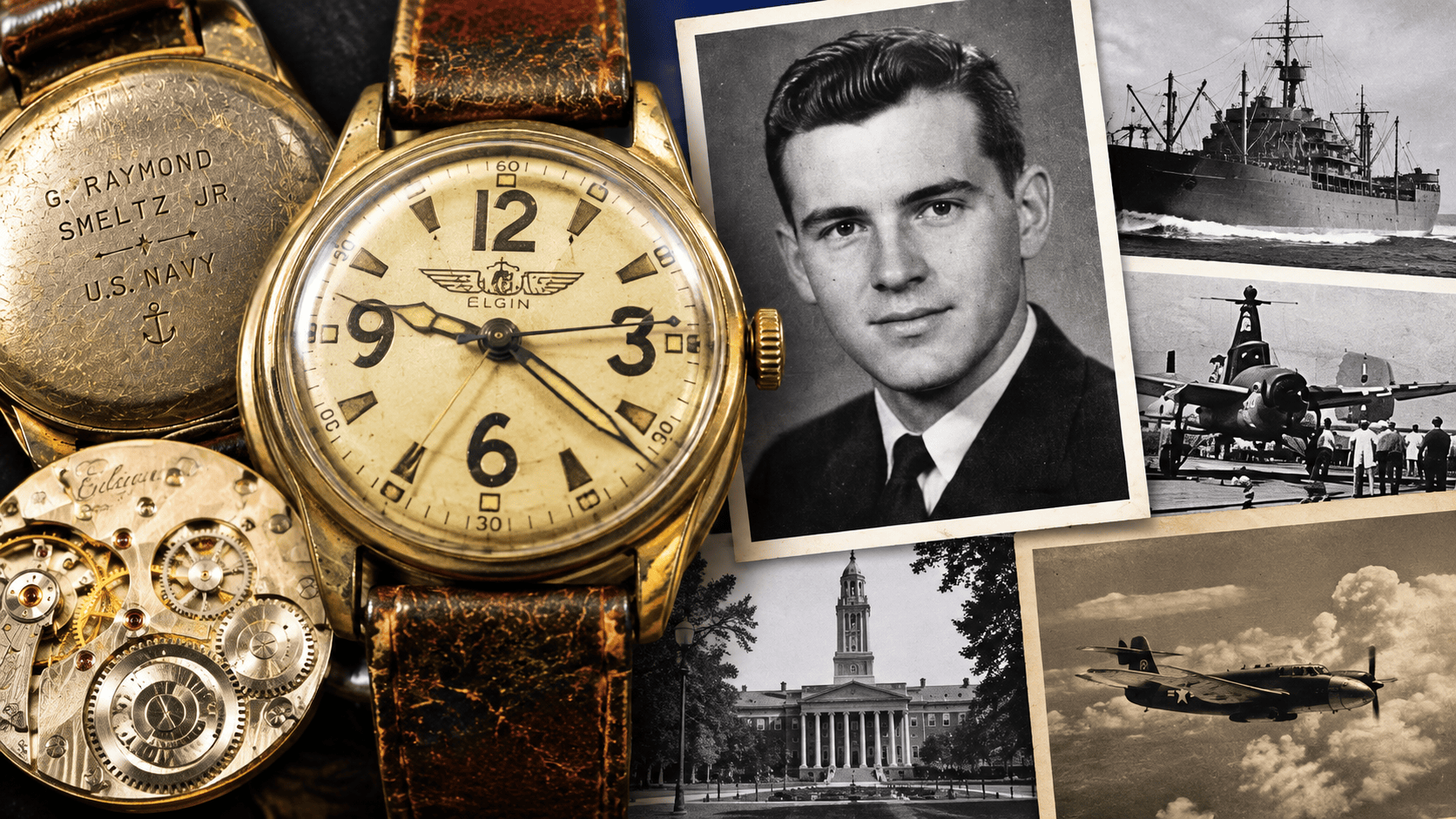
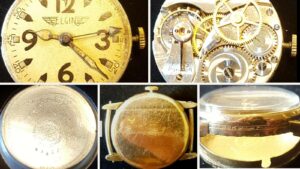
In August 2019, an unusual vintage Elgin wristwatch appeared for sale. The seller described it simply as a “Rare Elgin Military Aviator Watch.” It was far from pristine. The crystal was scratched, the movement would run for only a few seconds, and the case showed the evidence of a watch that had lived a life rather than spent decades inside a display case.
But the dial was what made the watch particularly interesting.
It featured the unmistakable aviation-inspired layout associated with Elgin watches of this period: oversized 12, 3, 6 and 9 numerals, luminous markers and a winged emblem surrounding the Elgin name.
And on the back was something far more personal.
A name.
G. Raymond Smeltz Jr.
That name opened the door to a story extending far beyond the watch itself.
A Young Man From Lancaster
Guy Raymond Smeltz Jr. was born in Lancaster, Pennsylvania, on October 2, 1924.
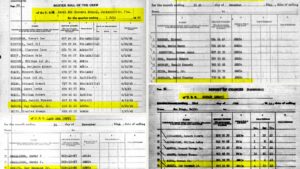
He attended J.P. McCaskey High School, where contemporary newspaper material documented him preparing for the next chapter of his life. Records collected with the watch research show him as a young man growing up in Lancaster before America entered the Second World War.
Then the world changed.
Smeltz entered the United States Navy during World War II
and served in the Pacific.
The surviving military records included with this watch’s research place him in naval service associated with aviation-support operations. One of the records identifies him with a Carrier Aircraft Service Unit, or CASU.
These units played an important but often overlooked role in the Pacific war. They existed to support, maintain and repair naval aircraft and keep aviation operations functioning. The research document notes that 69 Carrier Aircraft Service Units were formed between 1942 and 1946.
Other records in the archive connect Smeltz with the USS Alshain (AKA-55), an Andromeda-class attack cargo ship that served with the United States Navy.
Suddenly, the old aviation-style Elgin watch becomes more interesting.
Was This His Watch?
This is where history requires some restraint.
We have pieces of evidence, but we do not yet have every piece of the puzzle.
The watch surfaced through an estate-sale seller, and the research assembled around it connects the name G. Raymond Smeltz Jr. to the man whose life is documented in the accompanying records. The watch itself carries the physical evidence of decades of use.
What we cannot yet prove conclusively is exactly when Smeltz acquired the watch, who originally purchased it, or whether it accompanied him during his wartime service.
Those are precisely the unanswered questions that make provenance research fascinating.
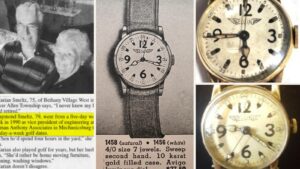
The movement carries serial number 34,480,554, which the original seller believed dated it to the 1930s. The case was described as 10K gold filled. When it was offered in 2019, the watch was not properly running; the seller reported that the seconds hand would move when the large gear was rotated, but only for approximately four or five seconds.
The watch had survived.
Its complete story had not.
The AVIGO Connection
The dial provides another clue.
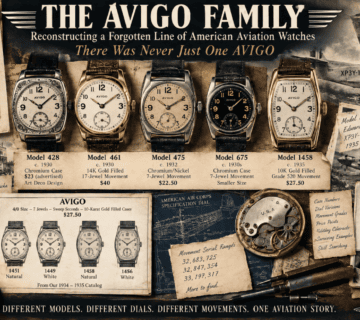
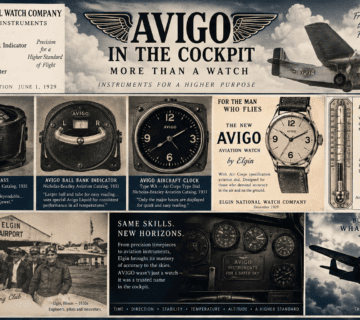
AVIGO was associated with Elgin’s aviation-watch designs, and the research accompanying this watch describes the AVIGO line as having been introduced around 1929, using the highly legible four-numeral aviation layout.
By 1935, advertising reproduced in the research shows an Avigo 1458 with oversized numerals, luminous markers and a gold-filled case, priced at $27.50. The document describes that model as using an Elgin Grade 502, seven-jewel manual-wind movement.
Smeltz’s watch is not simply labeled “AVIGO” on its dial.
Instead, it bears the Elgin name inside a winged emblem.
That distinction matters.
Rather than forcing the watch into a history we want it to have, AVIGO Watch Company is documenting it for exactly what it is: an intriguing piece of Elgin’s aviation-watch history whose relationship to AVIGO deserves further investigation.
And that investigation is continuing.
From the Pacific to Penn State
Smeltz survived the war and came home.
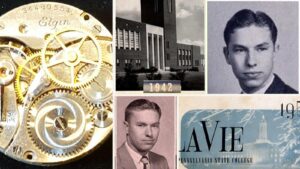
He attended Penn State University, earned a degree in civil engineering and played baseball for the Nittany Lions. He later worked as an engineer for PennDOT and Erdman Anthony Associates before retiring.
He married Marian and spent 59 years with her. Together they raised three children, and Raymond eventually became a grandfather five times over.
He remained an avid golfer and a fan of baseball and football.
G. Raymond Smeltz Jr. died on May 6, 2012, at the age of 87.
Seven years later, an old Elgin wristwatch appeared online.
And with it, his name resurfaced.
Why We Preserve These Stories
AVIGO’s return isn’t simply about reproducing the appearance of an old watch.
It’s about finding the watches that survived and discovering the people connected to them.
A scratched case matters.
An engraving matters.
A movement serial number matters.
An old newspaper clipping matters.
Because sometimes those fragments allow us to reconstruct the life that existed around a watch.
We don’t yet know whether G. Raymond Smeltz Jr. wore this watch while serving in the Pacific. We don’t know whether it was purchased for him, presented to him, or acquired at another point in his life.
And we won’t turn possibilities into facts simply because they make a better story.
What we do have is a remarkable surviving Elgin aviation watch, a name, a collection of historical records, and the beginning of a provenance trail connecting an object from America’s early aviation-watch era with the life of an American Navy veteran.
Nearly a century later, we’re still following that trail
.
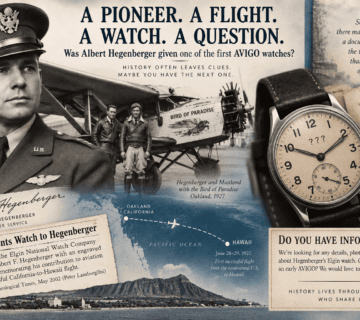
If you knew G. Raymond Smeltz Jr., recognize this watch, have information about similar Elgin aviation watches, or own an early AVIGO, we would love to hear from you.
Every photograph, memory, receipt, engraving and family story can help recover another piece of this nearly forgotten history.

No comment