The 1930 Nebraska Air Tour, 35 Airplanes Over the Plains — and the AVIGO Model 428 Waiting in Grand Island
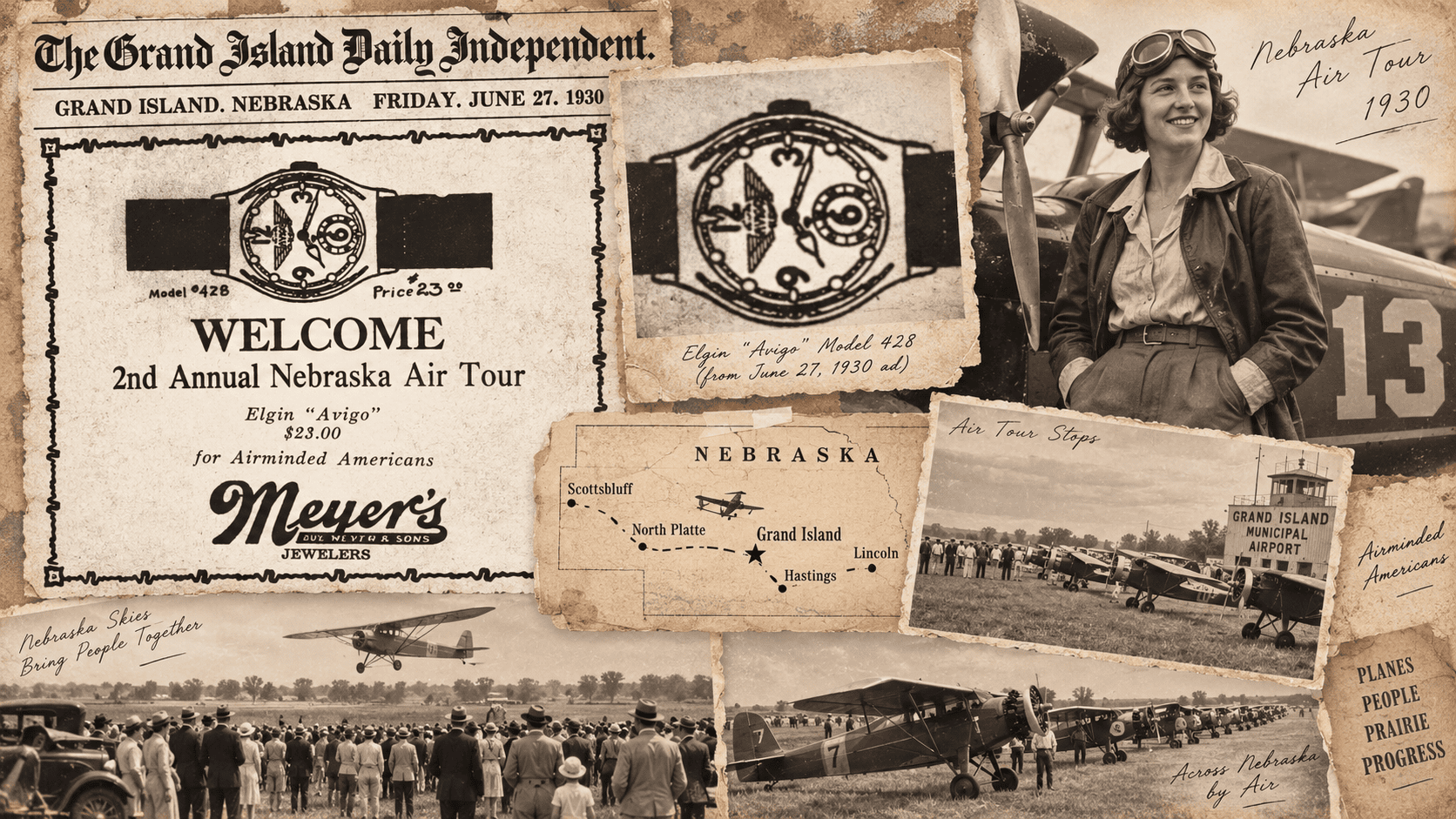
On Friday, June 27, 1930, readers of the Grand Island Daily Independent opened their newspaper to an advertisement that captured something larger than a wristwatch.
Across the center of the advertisement appeared a watch with four enormous numerals — 12, 3, 6 and 9. Beneath it were the words “WELCOME — 2nd Annual Nebraska Air Tour.” The watch was identified as the AVIGO Model 428, offered for $23 by Meyer’s Jewelers of Grand Island and marketed with a phrase that perfectly captured the enthusiasm surrounding American aviation at the time: “for Airminded Americans.”
There was no famous pilot pictured this time. No presentation ceremony and no record-breaking flight attached to one individual. Instead, AVIGO had been placed beside something arguably even more revealing about America in 1930: an entire state trying to convince its citizens that aviation belonged in their future.
The Second All Nebraska Air Tour was already moving across the state when the advertisement appeared. Dozens of aircraft were visiting communities that only a few years earlier might rarely have seen an airplane land nearby. Crowds gathered beside newly prepared airfields. Adults and children took airplane rides. Business leaders and city officials watched closely because an airplane landing in town was beginning to represent something much larger than entertainment.
It represented progress.
And in Grand Island, a jeweler looked at that moment and decided the right watch to put beside it was an AVIGO.
Nebraska Was Becoming “Air Conscious”
The Nebraska Air Tour was not simply an air show created to entertain spectators. Its origins were connected to a much broader effort to convince communities that aviation infrastructure would become essential to their economic future.
Historian Les Valentine documented the story in his study of the First All Nebraska Air Tour of 1929. Aviation advocates associated with the Omaha Chamber of Commerce believed that bringing airplanes directly into Nebraska communities could accomplish something speeches and newspaper editorials could not. Residents could see the aircraft up close, meet pilots, watch them operate and, in many cases, climb aboard for their first flight.
At the end of the 1920s, that mattered. Many Americans still thought of airplanes as dangerous novelties, machines flown by military pilots, stunt flyers and wealthy adventurers. Aviation promoters wanted communities to begin thinking differently. Airplanes were becoming transportation, and cities without adequate airports risked being left behind.
The first statewide tour in September 1929 carried that message through communities including Lincoln, Fremont, Norfolk, Columbus, York, Grand Island, Kearney, Broken Bow, North Platte, McCook, Holdrege and Hastings before returning to Omaha. According to Valentine’s research, an estimated 60,000 people participated in celebrations connected with the tour, and thousands took airplane rides. Organizers regarded the experiment as such a success that the Second All Nebraska Air Tour was scheduled for June 23–28, 1930.
Read History Nebraska’s complete history of the First All Nebraska Air Tour
The objective was not merely to make Nebraska fascinated with airplanes. It was to make Nebraska air conscious — to persuade towns that aviation was becoming part of the same transportation system that already included railroads and highways.
By the following summer, the airplanes were coming back.
Thirty-Five Airplanes Descend on Hastings
One of the clearest surviving descriptions of the Second Nebraska Air Tour comes from Hastings, where the fleet arrived on Saturday, June 28, 1930 — one day after the AVIGO advertisement appeared in Grand Island.
Documentation prepared for the National Register of Historic Places preserves contemporary reporting from the event. The arriving tour was described as the “most comprehensive display of aircraft ever assembled in this vicinity,” while a newspaper banner proclaimed: “Fliers Bring Gospel of Modern Air Travel.”
Thousands of people began arriving early. Cars streamed toward Hastings Municipal Airport while spectators waited for the approaching aircraft. Then the airplanes began landing.
There were not five or ten.
There were 35 airplanes.
By noon, the entire fleet was lined along both sides of the runway. Local officials welcomed the pilots and passengers while the field filled with spectators. Pilots reportedly praised the unusual smoothness of the runway, and the local newspaper reported that plans were already underway to triple its length once the surrounding wheat crop had been harvested.
Read the National Register history of Hastings Municipal Airport and the 1930 Nebraska Air Tour
That small detail gets to the heart of what the Nebraska Air Tours were accomplishing. The airplanes did not simply arrive, perform for a crowd and disappear over the horizon. Communities were looking at what arrived and asking themselves what they needed to build next.
Longer runways. Hangars. Better airports. Businesses serving aircraft and passengers.
Aviation was beginning its transition from spectacle to infrastructure.
The Woman Flying With Number 13
The Second Nebraska Air Tour also brought its own personalities, and one of the most memorable was aviator Nellie Willhite, whose airplane carried a large number 13.
Willhite had embraced the supposedly unlucky number as part of her public identity. History Nebraska records that she participated in the 1930 All Nebraska Air Tour as the “Thirteen Girl.” Her attachment to the number was not arbitrary. Her first solo flight had taken place on Friday the thirteenth. She had enrolled in aviation school as its thirteenth student, became its thirteenth graduate and completed thirteen hours of instruction before making her first solo flight.
Read History Nebraska’s story about Nellie Willhite and the number 13
Her presence helps explain what people experienced when an air tour arrived in their town. This was not a procession of anonymous machines moving from airport to airport. It was a traveling collection of personalities, aircraft, stories and personalities that descended almost literally from the sky.
For many spectators, these pilots were their introduction to aviation itself.
Grand Island Had Already Learned the Lesson
Grand Island’s relationship with the Air Tour had changed dramatically in less than a year.
During preparations for the first tour in 1929, enthusiasm in the city was initially weak enough that the Grand Island Daily Independent criticized the lack of local interest and encouraged residents to demonstrate that Grand Island was as progressive as other Nebraska communities.
Then the airplanes arrived.
Roughly 5,000 spectators came to Grand Island during the first tour. Residents inspected airplanes, watched the activity surrounding the visiting pilots and took rides. Whatever doubts existed about whether aviation could attract public interest largely disappeared. Valentine’s historical study documents how the first tour generated enormous public participation across Nebraska and helped strengthen support for aviation development in the communities it visited.
Less than a year later, the atmosphere in Grand Island had changed. Instead of a newspaper urging citizens to become interested in aviation, the same newspaper was carrying an advertisement welcoming the Second Annual Nebraska Air Tour.
And Meyer’s Jewelers had an AVIGO waiting for them.
That progression may be one of the most interesting parts of the story. In 1929, Grand Island had to be encouraged to care about the arrival of airplanes. In 1930, a local retailer believed the Air Tour had become important enough to use it as the centerpiece of an advertisement for an aviation wristwatch.
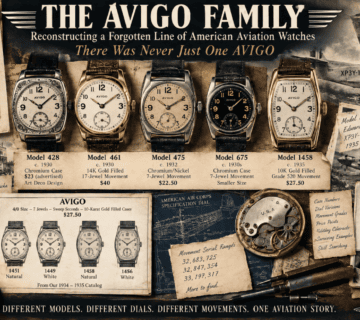
The AVIGO Model 428
The watch pictured in the June 27, 1930 advertisement is specifically identified as Model 428. That makes the advertisement particularly valuable to AVIGO history because it does more than establish a broad connection between the brand and aviation. It ties a specific AVIGO reference to a known city, retailer, date and aviation event.
A documented surviving AVIGO 428 shows the distinctive Art Deco styling associated with the model: a cushion-shaped case, prominent aviation-style numerals and the characteristic AVIGO aviation dial. The surviving example documented by specialist site ElginWristwatches.com is powered by an Elgin Grade 485 seven-jewel manual-wind movement. The site dates its example to approximately 1931.
See the documented surviving AVIGO Model 428
There is an interesting historical wrinkle worth preserving rather than attempting to smooth over. The specialist surviving-watch example is dated circa 1931, while the Grand Island advertisement establishes that the AVIGO Model 428 was already being advertised by June 27, 1930. That is not necessarily a contradiction. Dating surviving vintage watches to an approximate year is common, whereas a dated contemporary newspaper advertisement provides particularly strong evidence that the model was commercially available by that specific date.
The newspaper also advertised the Model 428 for $23, while the surviving-watch specialist records a 1931 price of $22.50. Again, small differences like these are exactly the sort of historical details worth documenting as additional advertisements and catalogs are discovered rather than forcing every surviving source to match perfectly.
“For Airminded Americans”
Perhaps the most revealing words in the Grand Island advertisement are not AVIGO, Model 428 or even $23.
They are “for Airminded Americans.”
Today the phrase sounds almost quaint. In 1930, being “air-minded” carried a much larger cultural meaning. It described people who believed aviation mattered — people interested in aircraft, airports, pilots, air mail, speed, technology and the new transportation network beginning to form across America.
The Nebraska Air Tour was essentially a statewide campaign to create more of those people. Its organizers wanted Nebraskans to stop thinking about airplanes solely as carnival attractions or machines for daredevils and instead understand that aviation was becoming part of the country’s future.
That makes Meyer’s Jewelers’ choice of language particularly revealing. When the store advertised an AVIGO “for Airminded Americans,” it was doing more than identifying a target customer. It was selling an identity.
Buying the watch suggested that you belonged to the people paying attention to what was happening above them.
What the Advertisement Does — and Does Not — Prove
There is an important historical distinction to maintain. The Grand Island advertisement does not prove that AVIGO officially sponsored the Second Nebraska Air Tour. It does not establish that participating pilots received AVIGO watches, that organizers endorsed the Model 428 or that AVIGO was designated the official watch of the event.
The evidence should not be stretched beyond what the advertisement actually says.
What it proves is narrower — and still extremely valuable. On June 27, 1930, Meyer’s Jewelers of Grand Island deliberately connected the AVIGO Model 428 with the arrival of the Second Annual Nebraska Air Tour, advertised the watch for $23 and marketed it directly to “Airminded Americans.”
That tells us something important about where AVIGO was being positioned culturally. The watch did not need to be strapped to the wrist of one of the pilots flying those 35 airplanes to become part of the aviation story. It was being marketed to the thousands of people standing on the ground watching them arrive.
When an Airplane Could Change a Town
This AVIGO story is different from the stories surrounding Edward Sizer, George Hutchinson, Livingston Irving or Martin Jensen. There is no single hero at its center.
The hero is the movement itself.
It is thousands of people standing beside grass runways as airplanes appear on the horizon. It is communities realizing that an airport could soon become an important transportation connection. It is city leaders talking about longer runways and new hangars. It is pilots giving people their first airplane ride and an aviatrix arriving with a giant number 13 painted on her machine because she knows the crowd will remember her.
In Hastings, 35 airplanes filled a municipal airfield while thousands of spectators gathered to see what modern air travel looked like. In Grand Island, only a year after local residents had been challenged to show more enthusiasm for aviation, a jeweler was now using the arrival of the next Air Tour as a reason to advertise a watch.
Sitting in the middle of that extraordinary cultural transition was a small newspaper advertisement:
“WELCOME — 2nd Annual Nebraska Air Tour.”
Above those words was an AVIGO Model 428.
The price was $23.
And the people it was intended for were identified with just two words:
“Airminded Americans.”
Nearly a century later, that phrase may be one of the clearest descriptions yet discovered of exactly who AVIGO believed its watches belonged to.
Historical Sources and Further Reading
History Nebraska — The First All Nebraska Air Tour, 1929
National Park Service — Hastings Municipal Airport National Register Documentation

No comment