
In the Skies
Martin Jensen, the Aloha, the MGM Lion — and the Famous Aviator Chosen to Introduce AVIGO to Airmen
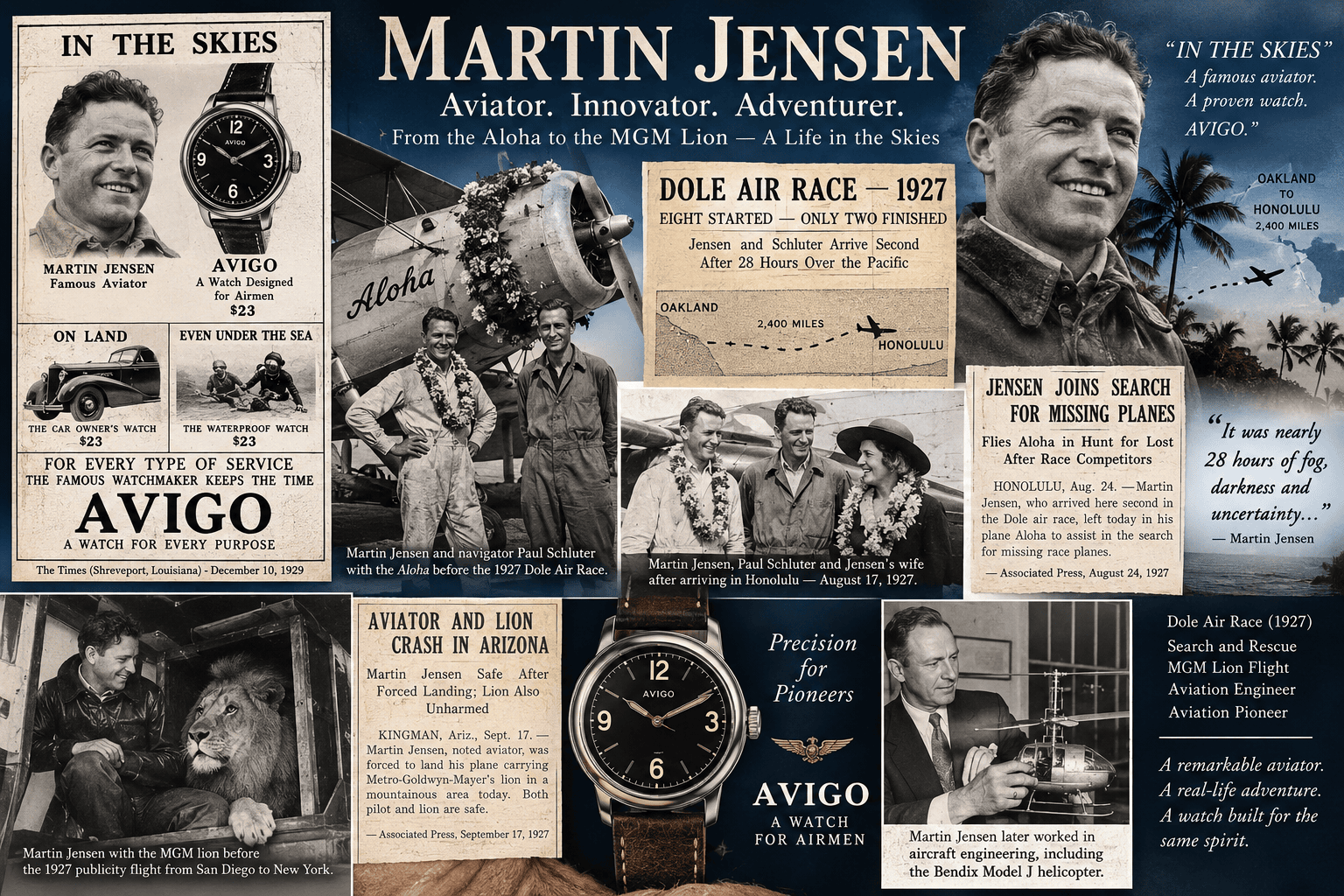
In December 1929, readers of a Louisiana newspaper could look across a jewelry advertisement and see three very different worlds of timekeeping: “IN THE SKIES,” “ON LAND,” and “EVEN UNDER THE SEA.” At the top of the advertisement, representing the sky, was the smiling face of one of the most recognizable American aviators of the moment: Martin Jensen. Beside him was an AVIGO.
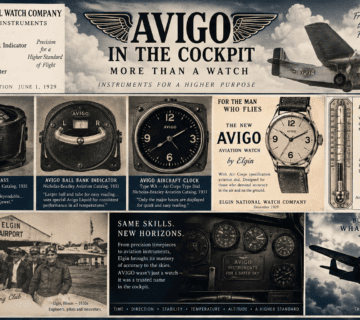
The surviving advertisement identifies Jensen as a “famous aviator” and describes the AVIGO as a watch “designed for airmen,” featuring a government-specification dial and a $23 price. Unlike the Livingston Irving and George Hutchinson material, the advertisement does not show Jensen being presented with a watch. What it proves is different, but historically important: Jensen’s reputation was deliberately being used to place AVIGO inside the world of real aviation.
That distinction matters. We do not yet have evidence proving that Jensen designed the AVIGO, helped develop it, or even personally owned the watch shown in the advertisement. What we do have is a period advertisement pairing AVIGO with a man whose life already sounded like something invented for a movie. He had flown across the Pacific in one of the deadliest air races in American history, gone back into the air looking for competitors who never arrived, worked as a barnstormer and stunt pilot, and, only weeks after his famous Hawaii flight, climbed into another airplane carrying one of Hollywood’s most unusual passengers: a live lion.
Before AVIGO, There Was the Aloha
In the summer of 1927, aviation had become one of America’s great obsessions. Charles Lindbergh had crossed the Atlantic only months earlier, and suddenly oceans looked less like barriers and more like challenges waiting for the right pilot and airplane.
Pineapple magnate James D. Dole offered a prize for aircraft attempting the flight from Oakland, California, to Honolulu. The resulting Dole Air Race, also known as the Dole Derby, became one of the most dangerous events of aviation’s early years. Martin Jensen was one of Hawaii’s most popular entrants. His wife actively helped secure an airplane for the attempt, and the Breese monoplane was christened Aloha in a distinctly Hawaiian ceremony, complete with Hawaiian music, hula dancers and a painted flower lei around the nose.
Explore Hawaii Aviation’s history of Martin Jensen and the Dole Derby
Jensen and navigator Paul Schluter lined up at Oakland on August 16, 1927. What happened around them would have given almost anyone second thoughts. Aircraft crashed while trying to depart. Others turned back with mechanical trouble. Two airplanes that successfully left Oakland would disappear over the Pacific and never be found.
Jensen kept going.
Twenty-Eight Hours Over the Pacific
The Aloha crossed the California coast and headed into open ocean without modern navigation systems, GPS, satellite weather or the sophisticated instrumentation pilots depend upon today. Jensen later remembered the flight as nearly 28 hours of fog, darkness, exhaustion and uncertainty.
In a 1987 interview with the Los Angeles Times, Jensen recalled trying to climb above the fog only to become disoriented by vertigo. He entered dangerous spins and relied on his previous stunt-flying experience to recover. The aircraft also flew extraordinarily close to the surface of the Pacific during portions of the journey.
Life inside the Aloha was hardly comfortable. Jensen and Schluter were separated by fuel tanks and communicated through an improvised trolley line equipped with a clothespin for sending messages between their positions. Schluter also had to spend considerable time manually pumping fuel during the long crossing.
Read the Los Angeles Times interview with Martin Jensen about the flight
On August 17, Oahu finally appeared. Art Goebel’s Woolaroc reached Wheeler Field first. Martin Jensen and Paul Schluter arrived one hour and 58 minutes later, earning second place. Hawaii’s official aviation archive preserves numerous photographs of Jensen, Schluter, the Aloha and Jensen’s wife following their arrival at Wheeler Field.
View Hawaii Aviation’s photographs of Martin Jensen and the Aloha at the Dole Derby
Simply reaching Hawaii was an extraordinary accomplishment. But Jensen’s involvement with the Dole Race was not over.
Winning Did Not End the Flight
Two competing airplanes, the Golden Eagle and Miss Doran, were missing somewhere over the Pacific. The celebration in Hawaii quickly became overshadowed by the search for the missing aviators. The Dole Derby ultimately became remembered not simply as a race, but as one of the most tragic chapters in the early history of trans-Pacific aviation. Jensen later recalled knowing every one of the people who died in connection with the race.
The loss of life also demonstrated how primitive long-distance aviation remained. Hawaii’s aviation history records that only two of the competing aircraft completed the journey to Oahu, while others failed to leave Oakland successfully or disappeared at sea.
Jensen officially finished second. In a very real sense, simply finishing had been the greater achievement.
Then Hollywood Gave Him a Lion
Less than a month after surviving the Dole Race, Martin Jensen somehow found himself involved in a story even stranger than the Pacific crossing.
Metro-Goldwyn-Mayer wanted publicity involving its famous lion mascot. The plan called for the animal to be flown from California toward New York in a specially modified Ryan B-1 Brougham. A cage was incorporated into the aircraft, along with extra fuel and supplies for the lion.
MGM chose Martin Jensen to fly it.
On September 16, 1927, Jensen took off from near San Diego with the lion aboard. The flight did not go as planned. After encountering trouble over Arizona, Jensen ended up crash-landing in a remote canyon. The airplane was badly damaged, but both Jensen and the lion survived without serious injury.
Jensen left food, milk and water for his unusual passenger and set out on foot looking for help. According to material preserved by the University of Wyoming’s American Heritage Center, it took him four days to reach a ranch. After eventually making contact with MGM, Jensen discovered that the studio’s immediate concern was the welfare of its famous lion. The animal was later rescued and transported onward by truck.
Read the American Heritage Center’s story of Martin Jensen and MGM’s lion
The entire episode sounds like Hollywood fiction.
It actually happened.
“IN THE SKIES”
Two years later, Martin Jensen appeared beside AVIGO.
The surviving advertisement is arranged almost like a declaration of where precision timekeeping belonged. Across the top is the phrase “IN THE SKIES.” Jensen’s portrait appears beside the aviation watch. Below are separate sections dealing with timekeeping on land and underwater.
The research compilation identifies the Jensen advertisement with The Times of Shreveport, Louisiana, dated December 10, 1929, although the complete bibliographic citation should still be independently verified before treating that publication information as final. What the advertisement itself makes unmistakably clear is its central message: AVIGO was being marketed specifically as a watch for airmen, and Jensen’s aviation reputation was being used to give that claim credibility.
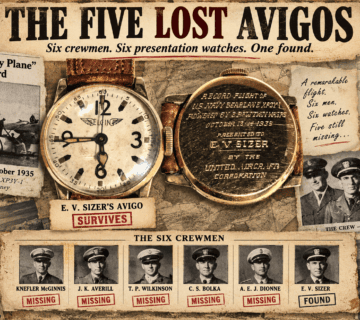
That makes the Jensen advertisement historically different from several other known AVIGO stories. With Edward Sizer, there is a surviving presentation watch tied to a specific record flight. With George Hutchinson and Livingston Irving, period advertisements depict named aviators receiving AVIGO watches. With Jensen, the surviving evidence shows something broader. AVIGO was being positioned commercially alongside one of America’s genuine aviation personalities.
Why Martin Jensen Was the Right Face for AVIGO
By 1929, Jensen had already become exactly the kind of figure advertisers wanted when talking about the modern airplane age. He was not a studio actor dressed like a pilot. He had actually crossed the Pacific. He had flown through blind conditions over open ocean, recovered from dangerous spins, witnessed the tragic consequences of the Dole Race and crash-landed an airplane carrying a Hollywood lion.
His aviation career continued long after the AVIGO advertisement appeared. The Martin Jensen Papers, preserved by the American Heritage Center at the University of Wyoming, document decades of his aviation career through correspondence, photographs, scrapbooks, telegrams and technical reports. The collection records his later work with Bendix Aviation and his development of the experimental Bendix Model J single-seat helicopter using coaxial rotors. Jensen later joined Douglas Aircraft and remained involved in aviation engineering until his retirement in the mid-1960s. He died in San Diego on February 8, 1992.
Explore the Martin Jensen Papers at the American Heritage Center
His life had begun in an aviation world populated by barnstormers, wood-and-fabric airplanes and pilots attempting flights that had never been successfully completed. He lived long enough to see aviation become something almost beyond recognition compared with the world he entered as a young pilot.
Did Martin Jensen Actually Wear an AVIGO?
At this point, the historical evidence does not allow us to say that he did.
The advertisement proves that Jensen’s image was used alongside AVIGO and that the watch was explicitly marketed as being designed for airmen. It does not, by itself, prove Jensen personally owned the watch, received one from the jeweler, wore one during the Dole Race or participated in the watch’s development.
That is not a weakness in the story. It gives us the next investigation.
Jensen’s personal papers survive, and importantly, the archival collection specifically contains correspondence and documents related to the 1927 Dole Trans-Pacific Air Race, newspaper clippings, photographs, promotional materials and two large scrapbooks containing documents and newspaper coverage from the 1927 race. The archive also contains material concerning the MGM lion flight.
That means there is still somewhere to look. Those records could potentially contain photographs showing Jensen’s wrist, correspondence involving AVIGO or a jeweler, promotional agreements or other evidence explaining exactly how Jensen became associated with the watch.
Search the surviving Martin Jensen archival collection
A Watch Meant to Belong in the Sky
Martin Jensen lived long enough to see aircraft change almost beyond recognition. He began flying in the era of barnstormers and cloth-covered airplanes and eventually worked in the age of helicopters and modern aircraft engineering. Even late in life, aviation remained part of him. In 1987, at age 86, Jensen was writing to congratulate Dick Rutan and Jeana Yeager following their historic nonstop flight around the world.
Read the 1987 Los Angeles Times story about Jensen and the Voyager flight
Sixty years earlier, Jensen had been the man inside the Aloha, trying to keep a fragile airplane pointed toward an island somewhere beyond the fog. That is the Martin Jensen who appears beside AVIGO in 1929. Not a fictional airman. Not an actor wearing a costume. A man who had already crossed an ocean at a time when aviation was still struggling to prove what airplanes and their pilots could accomplish.
The advertisement called AVIGO a watch “designed for airmen.” Then it put Martin Jensen beside it.
For the history of AVIGO, that may be the most important part of the entire advertisement.
Historical Sources and Further Reading
Hawaii Aviation — Martin Jensen and Hawaii’s Aviation Pioneers
Hawaii Aviation — Martin Jensen Dole Derby Photo Archive
Hawaii State Archives — Jensen, Mrs. Jensen and Paul Schluter After the Dole Race
Los Angeles Times — Martin Jensen Remembers the 1927 Dole Air Race
American Heritage Center — When Lions Fly: Martin Jensen and MGM’s Lion
American Heritage Center / Archives West — Martin Jensen Papers, 1927–1990
Los Angeles Times — Pioneer Aviator Martin Jensen and the Voyager Flight

No comment