
Flying Efficiency Is Measured in Time
The Remarkable Story of Major Livingston G. Irving and His AVIGO Watch
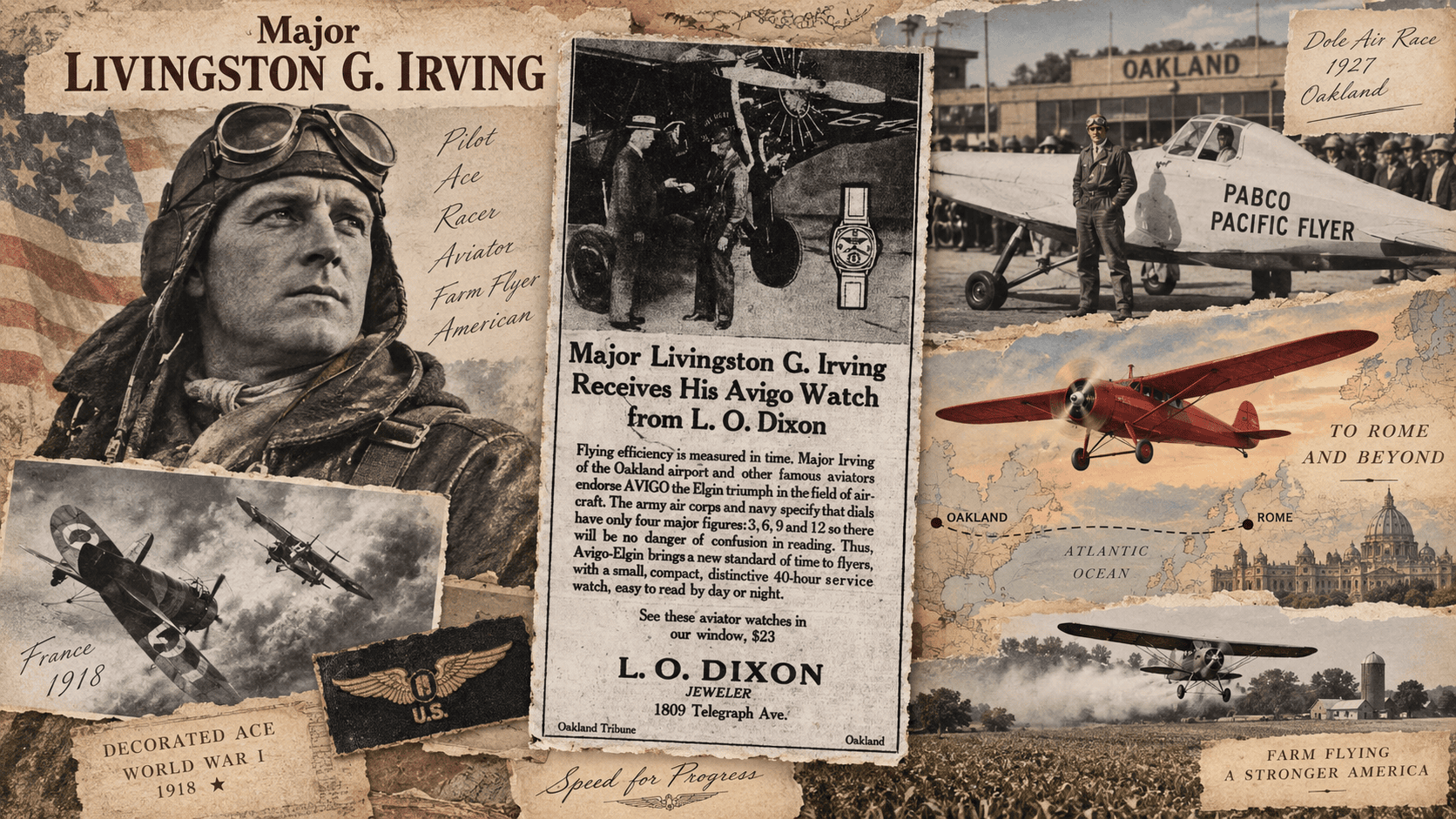
A surviving AVIGO advertisement from Oakland begins with a line that sounds like ordinary 1920s marketing: “Flying efficiency is measured in time.” But the man pictured beneath those words makes the statement considerably more meaningful. Standing beside an airplane is Major Livingston G. Irving, one of the remarkable early American aviators of his generation, receiving an AVIGO wristwatch from Oakland jeweler L. O. Dixon. The advertisement identifies Irving with Oakland Airport, describes AVIGO as an aviator’s watch, emphasizes the large 12, 3, 6 and 9 numerals designed for quick reading, and lists the watch at a retail price of $23.
This was not a watch being handed to a celebrity who merely enjoyed airplanes. By the time Irving received his AVIGO, he had already flown combat missions over France, earned the Distinguished Service Cross for extraordinary heroism, entered one of the most dangerous air races in American history and begun pursuing even more ambitious aviation projects from Oakland. Later, he would find an entirely different use for the airplane by turning his attention to agriculture. The deeper Irving’s life is examined, the more appropriate that old AVIGO advertisement becomes.
From the Battlefields of France to the Skies Above Oakland
Livingston Gilson Irving was born in San Francisco on October 31, 1895, and grew up in a prominent Berkeley family. His father, Samuel C. Irving, served as mayor of Berkeley and was associated with the Paraffine Companies. Livingston attended the University of California, worked with the family business and remained involved with military aviation after World War I. Before any of that, however, he had been a combat pilot with the 103rd Aero Squadron of the United States Army Air Service.
On October 10, 1918, near Bantheville, France, Irving and another American pilot encountered a formation of eleven enemy aircraft. Four were positioned above them, giving the Americans an enormous numerical disadvantage. Irving attacked anyway. His official Distinguished Service Cross citation states that he dove into the lower formation, destroyed one enemy airplane and, with the assistance of his fellow pilot, forced another to the ground. For that action, First Lieutenant Livingston Gilson Irving was awarded the Distinguished Service Cross for extraordinary heroism and was officially credited with an aerial victory.
That wartime record changes the way the later AVIGO advertisement reads. When the company associated Irving with aviation, it was not simply borrowing the image of a fashionable pilot. Irving had experienced aerial combat at a time when military aviation itself was still young. He had already learned, in the most unforgiving environment imaginable, how much distance, fuel, visibility and time mattered in the cockpit.
The Dole Air Race and a Solo Attempt Across the Pacific
After the war, Irving remained deeply involved with aviation just as America entered the spectacular and sometimes deadly record-breaking era of the 1920s. Charles Lindbergh’s Atlantic crossing had captured the world’s attention, and pilots were attempting flights that only a few years earlier would have seemed impossible. One of the most ambitious was the 1927 Dole Air Race, created after pineapple magnate James Dole offered a $25,000 prize for the first aircraft to fly from California to Honolulu and $10,000 for the second.
Irving entered the race with the Pabco Pacific Flyer, a specially prepared Breese-Wilde monoplane backed by the Paraffine Companies. Unlike most competitors, Irving intended to make the Pacific crossing without a separate navigator. Historical accounts describe him as qualified to handle both flying and navigation duties, allowing the weight normally assigned to a second crew member to be used for additional fuel. The Pabco Pacific Flyer was painted a striking orange and carried an Indian-head insignia associated with Irving’s old 103rd Aero Squadron.
On August 16, 1927, thousands of spectators gathered at Oakland Airport to watch the competitors depart for Hawaii. The scene quickly deteriorated into one of the most infamous episodes of early American aviation. Aircraft suffered mechanical problems and takeoff accidents before some had even cleared the airport. Irving’s heavily fueled Pabco Pacific Flyer briefly lifted from the field before settling back down and becoming stuck in marshland. After the aircraft was recovered, Irving attempted another departure, but the second effort also ended in a crash. He survived, although his attempt to reach Hawaii was over.
The race itself became a tragedy. Several aviators disappeared over the Pacific, and additional lives were lost during searches for the missing aircraft. Against that background, Irving’s survival was no small thing. A photograph preserved in aviation history shows the orange Pabco Pacific Flyer lifting from Oakland with Irving at the controls, capturing the brief moment when his solo attempt appeared to be underway.
For many men, surviving an experience like the Dole Race might have been enough aviation for one lifetime. Irving was not finished.
From Oakland to Rome
After the Pacific attempt, Irving became associated with another aircraft, a red monoplane appropriately known as the Red Wing, and pursued an even more audacious idea: a proposed nonstop flight from Oakland to Rome. Berkeley oral-history material recalls Irving taking passengers aloft from Oakland Airport as part of an effort to raise money for the flight. Members of the local community reportedly paid for rides to help finance the project.
The Port of Oakland’s own records provide a less glamorous but wonderfully human glimpse into this period. In 1929, Port Commission minutes record that Irving owed money for services rendered at the airport. The Port Attorney was authorized to “tie up” his airplane, specifically identified as the Red Wing, until Irving’s indebtedness was paid.
It is the kind of detail that brings early aviation down from the clouds. Irving could envision leaving California and flying all the way to Rome, but he still had to pay airport bills and finance the enormous cost of keeping an airplane operating. Record-setting aviation required courage, but it also required money, fuel, maintenance and an enormous amount of persistence.
Then Someone Handed Him an AVIGO
It was during this remarkable period of Irving’s life that the surviving AVIGO presentation photograph was made. The advertisement shows Irving beside an aircraft with Oakland jeweler L. O. Dixon and announces that “Major Livingston G. Irving Receives His Avigo Watch from L. O. Dixon.” Dixon’s business was located at 1809 Telegraph Avenue in Oakland, and the accompanying advertisement promoted AVIGO specifically in connection with aviation.
The advertisement explained that AVIGO’s prominent 12, 3, 6 and 9 numerals were intended to make the watch easier to read quickly and described it as suitable for day or night use. Its opening phrase, “Flying efficiency is measured in time,” becomes much more interesting when considered against Irving’s career. For him, time was not an abstract feature of a wristwatch. Time meant fuel consumption. It meant distance traveled. It meant remaining daylight, changing weather and navigation across stretches of territory where a small error could become catastrophic.
That is what makes the Irving presentation important to the history of AVIGO. The company was not merely placing an airplane in an advertisement and calling its watch an aviation watch. At least in this case, an AVIGO was placed directly into the hands of a man who had already fought in the skies over France and attempted to fly alone across thousands of miles of Pacific Ocean.
The Fighter Pilot Who Became a Flying Farmer
One of the most unexpected chapters in Irving’s story came after the record-flight era. Instead of spending the 1930s only chasing distance records and headlines, he began using aircraft for something far more practical: agriculture.
The 1933 Aircraft Year Book identifies Farm Flying Service of Oakland, operated by Livingston G. Irving, as an aviation business specializing in crop dusting and aerial seeding. The publication described Irving as a graduate of the University of California College of Agriculture and explained that his aircraft were used to sow rice in the spring, apply insecticide during the growing season and seed agricultural land from the air.
In a sense, Irving’s career reflected the transformation of aviation itself. He had first flown airplanes in war, when aviation was still a new military technology. He then became part of the great age of aviation spectacle, when pilots raced across oceans and attempted flights that captured newspaper headlines around the world. Later, he helped demonstrate that the airplane could become something else entirely: a practical working machine capable of changing industries on the ground.
The same man who once tried to race across the Pacific was now using airplanes to sow rice.
Remembered Alongside the Pioneers of American Aviation
Irving remained connected to the aviation world for decades. In 1976, nearly half a century after the Dole Race, he attended a remarkable gathering at Oakland Airport organized around people who had known or worked with Amelia Earhart. A 1977 publication of The Ninety-Nines, the international organization of women pilots, identified Colonel Livingston Irving as a World War I ace and a participant in the Dole Race. Others at the gathering included Neta Snook Southern, who had taught Amelia Earhart to fly, and Joseph Gurr, who had worked with Earhart’s radio equipment.
By that point Irving had witnessed nearly the entire transformation of twentieth-century aviation. He had flown during an age of open cockpits and early combat aircraft and lived long enough to see commercial jets crossing oceans routinely. Somewhere near the beginning of that enormous transformation, an Oakland photographer captured a small moment: Livingston Irving standing beside an airplane while a jeweler handed him an AVIGO wristwatch.
Where Is Livingston Irving’s AVIGO Today?
That question remains unanswered. The surviving advertisement establishes that the presentation took place. It identifies Irving, names L. O. Dixon and shows the moment the watch was presented. What has not yet been established is the exact publication and date of the advertisement, the specific reason Irving was selected to receive the watch, or what ultimately happened to his AVIGO.
It is possible that the watch remained with Irving or his family for years. It could have passed into a collection with its provenance eventually forgotten. It could even survive today, sitting in a drawer or watch collection with no one realizing that it once belonged to a decorated World War I pilot and participant in one of the most infamous air races of the 1920s. Those unanswered questions make Irving’s story more than a finished piece of history. They make it an ongoing investigation.
What is already known is remarkable enough. Livingston Irving fought enemy aircraft over France, attempted to cross the Pacific alone, dreamed of flying from Oakland to Rome and later turned airplanes into tools for American agriculture. He lived through the period when aviation changed from dangerous experimentation into an industry that reshaped the world.
And somewhere in the middle of that story, someone put an AVIGO on his wrist.
The old advertisement proclaimed that “Flying efficiency is measured in time.” For most people reading those words nearly a century ago, it was an advertising slogan. For Major Livingston G. Irving, it was something he had already spent much of his life proving.
Historical Sources and Further Reading
Livingston Irving — Distinguished Service Cross / Hall of Valor
San Francisco Museum — History of the 1927 Dole Air Race
HistoryNet — The Dole Air Race and Pabco Pacific Flyer
Port of Oakland — 1929 Board of Port Commissioners Minutes
1933 Aircraft Year Book — Farm Flying Service
The Ninety-Nines — 1977 Publication Mentioning Livingston Irving

No comment