Big Ben: The Flying Gas Station That Kept the Hunter Brothers Alive
Albert and Walter Hunter Had a Different Job in 1930 — Catch an Airplane That Refused to Land
The airplane that made the Hunter Brothers famous was called the City of Chicago. It stayed in the sky for more than twenty-three days and carried John and Kenneth “Beans” Hunter into the record books.
But another airplane may have had the harder schedule.
Its name was Big Ben.
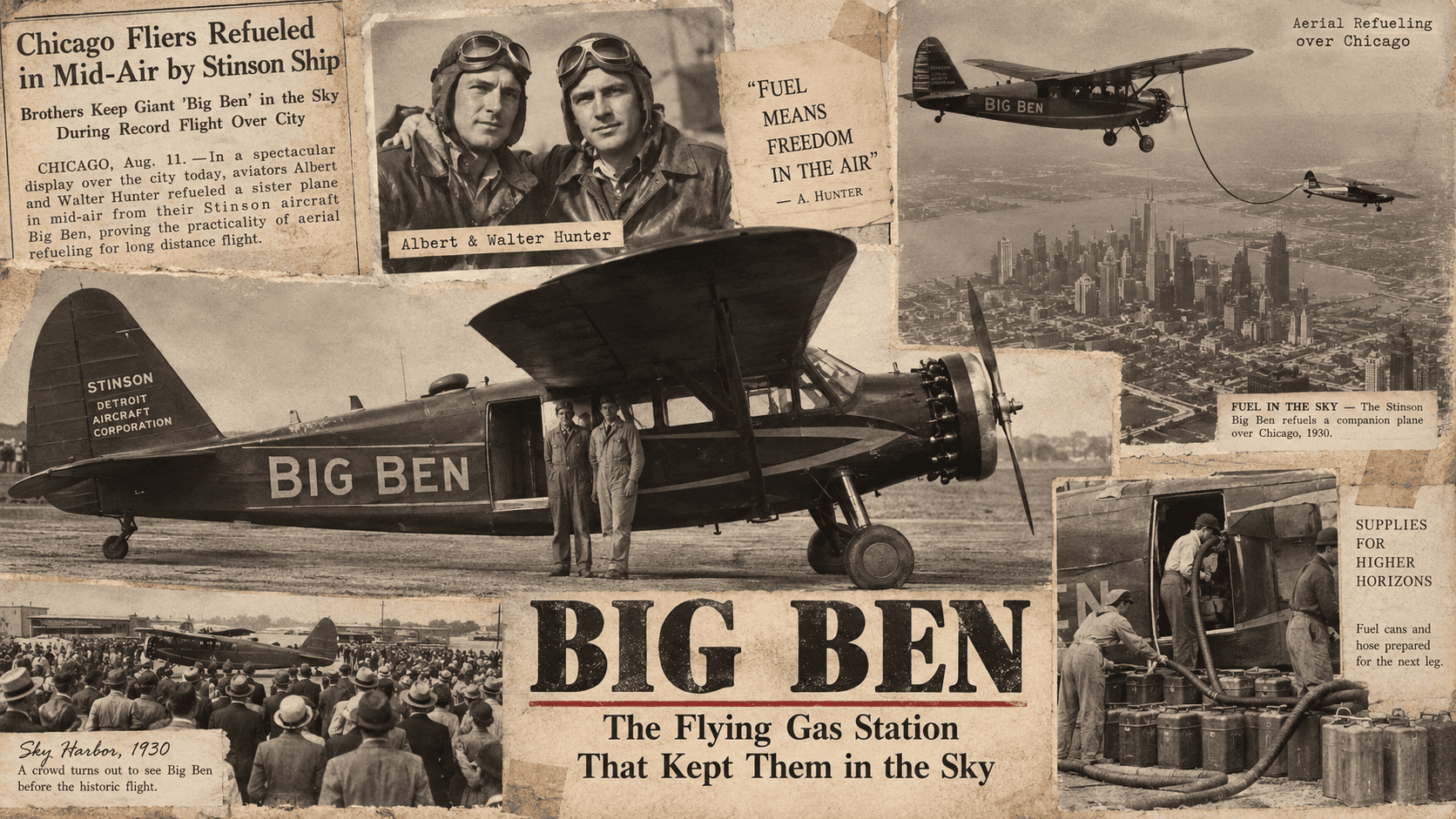
While the City of Chicago circled endlessly above Sky Harbor, Albert and Walter Hunter spent their days taking off, climbing toward their brothers, maneuvering one airplane dangerously close to another, transferring gasoline and supplies through the open air, separating, landing, reloading—and doing it all over again.
Big Ben was essentially a flying gas station in 1930, years before aerial refueling became the sophisticated military operation we know today.
The Fédération Aéronautique Internationale identifies the roles clearly: John and Kenneth flew the endurance airplane while Albert and Walter operated the refueling aircraft Big Ben.
FAI — Hunter Brothers 23-Day Endurance Flight
Big Ben Wasn’t an Ordinary Airplane Anymore
The surviving aircraft records tell us just how seriously Big Ben had been modified for the job.
The airplane was a Stinson SM-1 Detroiter, registration NR5326. Its official paperwork specifically described its intended use as a refueling plane for endurance flight. Passenger seats were removed and replaced by a 100-gallon gasoline tank inside the cabin. A large loudspeaker weighing around 100 pounds was installed in the baggage compartment, the left cabin door was removed, and even the aircraft’s wind-driven generator could be removed during refueling operations.
See the surviving historical record for Big Ben, NR5326
That changes the picture considerably.
Albert and Walter were not simply following their brothers around Chicago in another airplane. They were flying a machine that had been physically converted into an airborne service station.
There was a large tank of gasoline inside the cabin. There was an open doorway. There was equipment for passing fuel from one moving aircraft to another.
And there were no computers helping them hold position.
Imagine Trying to Hit a Moving Gas Station With Another Moving Airplane
The principle was straightforward. The execution was anything but.
Albert and Walter would bring Big Ben above the City of Chicago. A refueling hose was lowered from the tanker aircraft while both airplanes continued moving through the sky. The endurance airplane had to remain positioned underneath while the transfer took place.
The original 1930 film footage is one of the best ways to understand just how exposed the operation was. You can actually see Big Ben flying above the City of Chicago with the long refueling line suspended between them. There is no enclosed docking system, no modern tanker boom and no computerized assistance holding the aircraft together. (CriticalPast)
Watch the actual 1930 aerial-refueling footage
Every transfer required two pilots to put two airplanes close together and keep them there long enough to move what John and Kenneth needed.
Then Albert and Walter went back down.
Refueled.
Reloaded.
And came back.
Six Hours Became Three
At first, according to a detailed history compiled from contemporary Hunter Brothers material, Big Ben made contact with the endurance aircraft roughly every six hours.
Then the City of Chicago developed a leaking fuel tank.
The schedule tightened to approximately one rendezvous every three hours. Each contact could bring gasoline, oil, food and clean clothing. Their mother and sister Irene handled laundry and helped prepare meals on the ground before the supplies were sent back into the air.
Read the detailed Hunter Brothers historical account
That is where Albert and Walter’s story becomes fascinating in its own right.
A three-hour refueling cycle doesn’t care that you’re tired. It doesn’t care that it’s nighttime or that you just landed. The endurance airplane continues burning gasoline whether Big Ben’s crew feels rested or not.
For John and Kenneth, the problem was remaining airborne.
For Albert and Walter, the problem was making absolutely certain their brothers could remain airborne.
And Then Will Rogers Climbed Aboard
As the Hunter attempt began attracting enormous public attention, Big Ben became part of the spectacle as well.
One historical account records an extraordinary passenger: Will Rogers.
Rogers—the enormously popular American humorist, actor, columnist and aviation enthusiast—reportedly rode with Albert and Walter aboard Big Ben during one of its refueling contacts with the City of Chicago.
Think about that scene.
The Hunter Brothers’ endurance attempt had become famous enough that one of the biggest personalities in America climbed into the actual refueling airplane to watch the operation happen from inside.
That gives us an entirely different view of the flight’s cultural importance. People weren’t merely reading a number in the newspaper each morning. They were following an ongoing aviation drama happening directly above Chicago.
Big Ben was one of the places where that drama happened.
Albert and Walter Were Not Spectators
Photographs preserved by the Davis-Monthan Airfield Register show Big Ben, the City of Chicago and the Hunter Brothers in the weeks immediately following the record. The archive also records a July 20, 1930 visit by all four brothers to Davis-Monthan Airfield, only sixteen days after the record flight ended.
See historical photographs of the Hunter Brothers and Big Ben
The archive contains another small detail I love. Albert Hunter’s son, Hershel, later spoke with the site’s historian about his father and uncles. Albert eventually went into trucking, farming and moving houses and heavy equipment.
There is something oddly fitting about that.
In 1930 he helped move gasoline, oil and supplies through the sky. Later in life, he made a living moving things on the ground.
The Record Was Built From Above
When we picture endurance flying, our attention naturally goes to the airplane that never lands. That is where the official clock is running, and that is where the record is being measured.
But the Hunter Brothers had already learned in 1929 what happened when the support system failed. John and Kenneth had remained airborne for roughly eleven days during an earlier attempt before heavy fog prevented further aerial refueling and forced them to quit. The lesson was brutal and simple:
An endurance airplane can stay up only as long as somebody can reach it.
The following year, Albert and Walter became the answer to that problem.
They did not have to remain airborne for 553 hours themselves. Their challenge was different. They had to keep meeting an airplane that did.
Their job began every time Big Ben left the runway carrying another load.
It continued when the City of Chicago appeared ahead.
Then came the difficult part: closing the distance until two airplanes flying through open air were close enough to become, temporarily, one supply system.
Fuel passed downward.
Food followed.
Oil, clothing and whatever else the endurance crew needed went with it.
Then the aircraft separated and Albert and Walter headed back to prepare for the next rendezvous.
Some Records Have More Than One Airplane
The Houston Post-Dispatch advertisement published shortly after the flight captured an important truth almost accidentally. It celebrated the Hunter Brothers collectively and showed both airplanes—Big Ben above and the City of Chicago below—connected by the refueling line.
That is arguably the most accurate picture of the achievement.
Not one airplane.
Two.
Not two brothers.
Four.
One aircraft earned the record.
The other aircraft made the record possible.
And that is why Albert and Walter Hunter deserve their own chapter in this history. They weren’t the brothers waiting safely on the ground while John and Kenneth did something extraordinary.
They were up there with them—again and again—bringing the one thing an airplane that refuses to land eventually needs more than courage:
another airplane.


No comment