
Nearly a century after AVIGO first appeared during one of the most extraordinary periods in American aviation, surviving records are beginning to reveal a story that extends far beyond the wristwatch for which the name is remembered today.
It began, appropriately enough, with an old watch.
For decades, the surviving AVIGO wristwatches of the late 1920s and 1930s offered tantalizing clues about their origins. Their bold numerals, highly legible dials and unmistakable aviation styling seemed to belong naturally to the age of open cockpits, experimental aircraft and pilots who routinely risked their lives attempting flights no one had completed before.
There was never much doubt that AVIGO had been connected to aviation. The more interesting question was how deeply that connection actually ran.
As AVIGO Watch Company began retracing the history of the name nearly a century later, the answer started appearing in places far removed from vintage-watch catalogs. It appeared in aviation industry yearbooks, accounts of early American airports, military aviation records and the history of a small flying club in Illinois.
What emerged was a considerably bigger story.
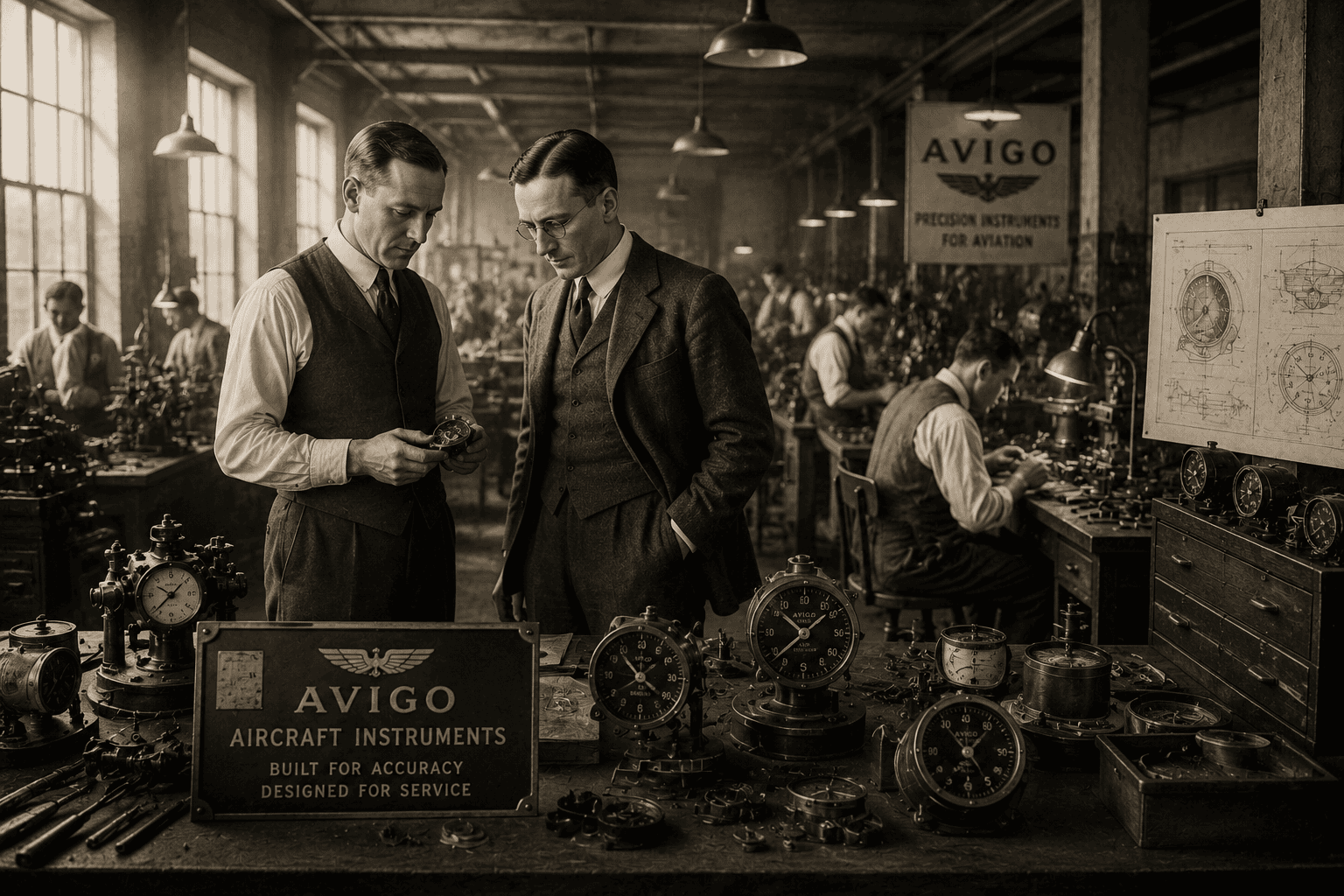
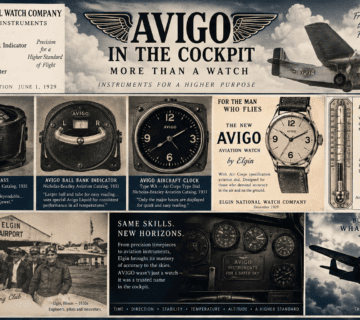
AVIGO had not simply borrowed the imagery of aviation to sell watches. The name existed inside the American aviation industry itself, attached to instruments, engineers and people who were participating in the extraordinary transformation of flight taking place at the end of the 1920s.
A Name From the Cockpit
America in 1929 was living through an aviation fever.
Charles Lindbergh had crossed the Atlantic only two years earlier. Aircraft manufacturers were multiplying. Cities were racing to establish airports. The military was investing heavily in navigation and instrumentation, while pilots continued setting records for distance, speed and endurance.
The airplane was rapidly changing from a fragile machine flown largely by sight and instinct into something capable of traveling farther, higher and through increasingly difficult conditions. That transformation created an enormous technical challenge: pilots needed better information.
They needed to know their direction, altitude and speed. They needed reliable engine information. They needed instruments capable of functioning inside an aircraft that vibrated, climbed, banked and operated under conditions fundamentally different from anything encountered on the ground.
It was in this environment that AVIGO appears in the historical record.
One of the clearest pieces of evidence comes from the 1929 Aircraft Year Book, an industry publication documenting the rapidly expanding American aviation business. Its account of the aircraft-instrument operation associated with AVIGO reported that the division had expanded and added equipment to what it described as an extensive line already “known to the trade as ‘Avigo’ instruments.”
Read the 1929 Aircraft Year Book archive
That brief sentence is enormously important to understanding what AVIGO originally represented.
The name wasn’t merely appearing in advertisements aimed at consumers who dreamed about airplanes. By 1929, AVIGO was being described in an aviation-industry publication as a name already known within the trade.
Once that became clear, the next question was inevitable: Who were the people behind it?
Finding the People Behind AVIGO
One of the first names to emerge from contemporary aviation records was Gordon C. Gillies.
A year before the 1929 reference to the expanding AVIGO instrument line, the 1928 Aircraft Year Book identified Gillies as manager of the Tachometer Division. By 1930, the same industry publication identified him as manager of the Aircraft Instrument Division.
The timing places Gillies in a remarkable position. He was managing the aviation-instrument operation during precisely the period in which AVIGO emerged and expanded.
There is an important distinction to make here. No document discovered so far establishes that Gillies personally invented AVIGO, selected the name or created its identity. Calling him the “founder of AVIGO” would go beyond what the surviving evidence allows us to say.
What the evidence does show is something arguably more interesting: Gillies was one of the people heading the operation while AVIGO was becoming part of the American aviation business.
Then another name began appearing in the records, and his story brought the investigation much closer to the airplanes themselves.
His name was Victor E. Showalter.
Years before his association with the aircraft-instrument business in Elgin, Showalter was already involved with the developing science of aerial navigation. In 1924, an official U.S. Air Service newsletter recorded an experimental navigation flight from McCook Field with Lieutenant Hugh Barksdale as pilot and Victor E. Showalter as navigator.
That was not an insignificant occupation in 1924.
Reliable long-distance aerial navigation was still being developed. The military was experimenting with new instruments, compasses and methods that might allow pilots to navigate accurately over distances and in conditions where familiar landmarks could no longer guide them.
Showalter subsequently appears among the personnel associated with navigation engineering work surrounding Army aviation projects of the era. Later, he turns up again—this time connected to the aviation-instrument operation in Elgin.
The more records that surfaced, the more difficult it became to view AVIGO simply as a watch brand.
And then the story acquired an almost cinematic detail.
The AVIGO Flying Club
During the same period that AVIGO instruments were becoming known within aviation, Elgin, Illinois, was attempting to establish an airport of its own.
Building an airport in the late 1920s wasn’t simply a matter of clearing a field and waiting for airplanes to arrive. Government requirements had to be satisfied, plans developed and a new kind of transportation infrastructure understood.
Historical accounts of Elgin’s first airport identify Victor Showalter, described as an engineer with the instrument division, as responsible for much of the planning necessary to obtain government approval for the field. The same account notes that the company was producing aviation equipment including tachometers and an AVIGO magnetic compass.
Read the history of Elgin’s first airport
Then comes a detail that brings the entire period to life: Showalter was also an active member of the Elgin AVIGO Flying Club.
Suddenly, the connection becomes remarkably tangible.
An engineer associated with the operation producing AVIGO instruments was helping establish an airport while simultaneously participating in a flying club carrying the AVIGO name. These were not people sitting safely outside the aviation revolution and borrowing its imagery. They were participating in it.
The club itself has not disappeared completely from the historical record. Decades later, the Elgin History Museum’s Crackerbarrel publication devoted an article to the AVIGO Flying Club, suggesting that photographs, names, recollections or additional documentation may still exist in local archives.
Explore the Elgin History Museum historical index
For a company attempting to reconstruct its history almost a century later, discoveries like these create as many questions as they answer. Who else belonged to the club? What airplanes did they fly? Were Gillies and other people involved with the instrument operation members? Are photographs sitting in an archive somewhere with names written on the back?
Those questions remain open.
But the evidence already discovered establishes something important: by the end of the 1920s, AVIGO belonged to a much broader aviation world than the wristwatch alone suggests.
From the Instrument Panel to the Wrist
That context changes how the surviving AVIGO wristwatches should be viewed.
Without the aviation records, it would be easy to look at one today and assume it was simply a conventional wristwatch styled to appeal to America’s growing fascination with pilots. Aviation was enormously fashionable, after all, and manufacturers across the country were eager to associate their products with the new heroes of flight.
AVIGO appears to have come from a different direction.
The name was already associated with aviation instrumentation. An AVIGO compass was being produced. The people surrounding the operation were involved with aviation engineering and airport development. There was even an AVIGO Flying Club.
Against that backdrop, putting AVIGO on a highly legible wristwatch doesn’t look like an attempt to invent an aviation identity. It looks like an extension of one that already existed.
And several years later, the relationship between AVIGO watches and aviation would produce one of the most remarkable artifacts yet discovered in the company’s history.
It came from a record-setting flight across America.
A Record Flight—and Six Gold Watches
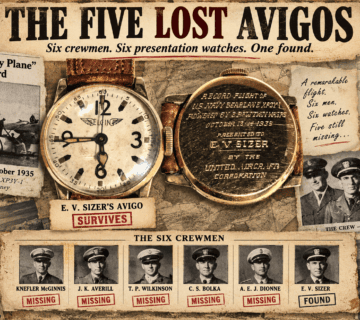
On October 13, 1935, six U.S. Navy aviators departed Coco Solo in the Panama Canal Zone aboard an experimental flying boat designated XP3Y-1.
The aircraft represented the leading edge of American aviation technology. Powered by Pratt & Whitney Twin Wasp engines, the enormous flying boat was being tested at a time when the Navy was exploring the possibilities of long-range maritime aviation.
Its crew pushed that possibility dramatically.
They flew nonstop from Panama to the San Francisco Bay area, remaining airborne for approximately 34 hours and covering thousands of miles before reaching California. The aircraft they were testing would eventually evolve into the legendary PBY Catalina, the flying boat that became one of the most recognizable and important maritime aircraft of the Second World War.
The flight deserved commemoration, and United Aircraft Corporation chose an unusually personal way to do it.
Gold AVIGO wristwatches were presented in connection with the achievement.
One of those watches survives today.
It belonged to crewman Edward Vernon Sizer, and unlike so many objects whose histories have been lost over the decades, Sizer’s AVIGO still carries its story directly on its case. The 10-karat gold watch was specially engraved with details commemorating the XP3Y-1 flight, including references to the aircraft, its Pratt & Whitney engines, the October 1935 flight and Sizer himself.
See Edward Sizer’s surviving gold AVIGO and the history of the XP3Y-1 flight
It is difficult to imagine a better physical representation of what AVIGO had come to mean.
A name that appeared alongside aviation instruments during the industry’s formative years was now engraved in gold and presented in connection with men testing an experimental aircraft at the limits of long-distance flight.
The watch had become part of the aviation story rather than simply something designed to resemble it.
A History Still Being Reassembled
Nearly a century later, much of the AVIGO story remains frustratingly incomplete.
We still do not know who first conceived the name. No document discovered so far definitively identifies the person who designed the original winged emblem. Gordon Gillies appears in the contemporary records as the man managing the aviation-instrument operation during AVIGO’s formative period, but that doesn’t tell us precisely what role he played in creating the AVIGO identity.
Victor Showalter’s trail is richer, stretching from early experimental aerial-navigation work to aviation engineering, airport development and the AVIGO Flying Club. Yet his complete role within AVIGO remains to be reconstructed.
There are undoubtedly other people whose names haven’t been found yet.
Somewhere there may be company correspondence explaining why the AVIGO name was chosen. An old photograph may show the members of the flying club standing beside their airplane. Additional instruments may survive in private collections. Other presentation watches may still sit in drawers belonging to descendants who have no idea how unusual the object in their possession actually is.
That is the fascinating—and occasionally maddening—part of reconstructing history after almost a hundred years. It rarely arrives as one perfectly preserved story. It comes back in fragments: a sentence in a 1929 aviation yearbook, a name in a military newsletter, an airport history, a flying club mentioned in a local publication, an old aircraft instrument and a gold watch whose engraving survived long after the people involved were gone.
Piece by piece, those fragments are beginning to reconnect.
And the picture they form is considerably more interesting than the simple story of an old aviation watch.
The Name Flies Again
Today, AVIGO is being rebuilt as a watch company for a new generation, but rediscovering this history has changed what that revival means.
There is always a temptation when resurrecting a historical name to make the past cleaner, more complete and more dramatic than the evidence allows. AVIGO doesn’t need that.
The history that can actually be documented is compelling enough.
During the formative years of American aviation, AVIGO instruments were known within the aviation trade. Engineers associated with the operation were involved with the developing world of flight. An AVIGO Flying Club existed while American cities were building the infrastructure that would make widespread aviation possible. The AVIGO name moved from aircraft instrumentation to the wrist, and by 1935 a gold AVIGO was being used to commemorate a record-setting flight by U.S. Navy aviators aboard an experimental aircraft that would help give birth to the PBY Catalina.
There are still missing chapters, and AVIGO Watch Company intends to keep looking for them.
Perhaps the next discovery will come from an aviation archive. Perhaps it will be buried in a century-old company publication. Perhaps someone will recognize a grandfather in an AVIGO Flying Club photograph. Perhaps another gold presentation watch will surface with a name engraved on the back.
Whatever comes next, the evidence already uncovered has answered the most important question.
AVIGO’s connection to aviation wasn’t a story invented for a watch.
It was a watch born from a world AVIGO was already part of.
Nearly a century later, as the name prepares to fly again, that distinction matters.
AVIGO was there.

No comment