AVIGO WAS THERE: THE FORGOTTEN AVIATION STORY WE’RE ONLY NOW BEGINNING TO UNCOVER
Nearly a century after AVIGO appeared during the golden age of American flight, aviation records, military documents and newly examined correspondence are revealing that the name’s connection to aviation may have run far deeper than the wristwatch for which it is remembered today.
The investigation began with a watch.
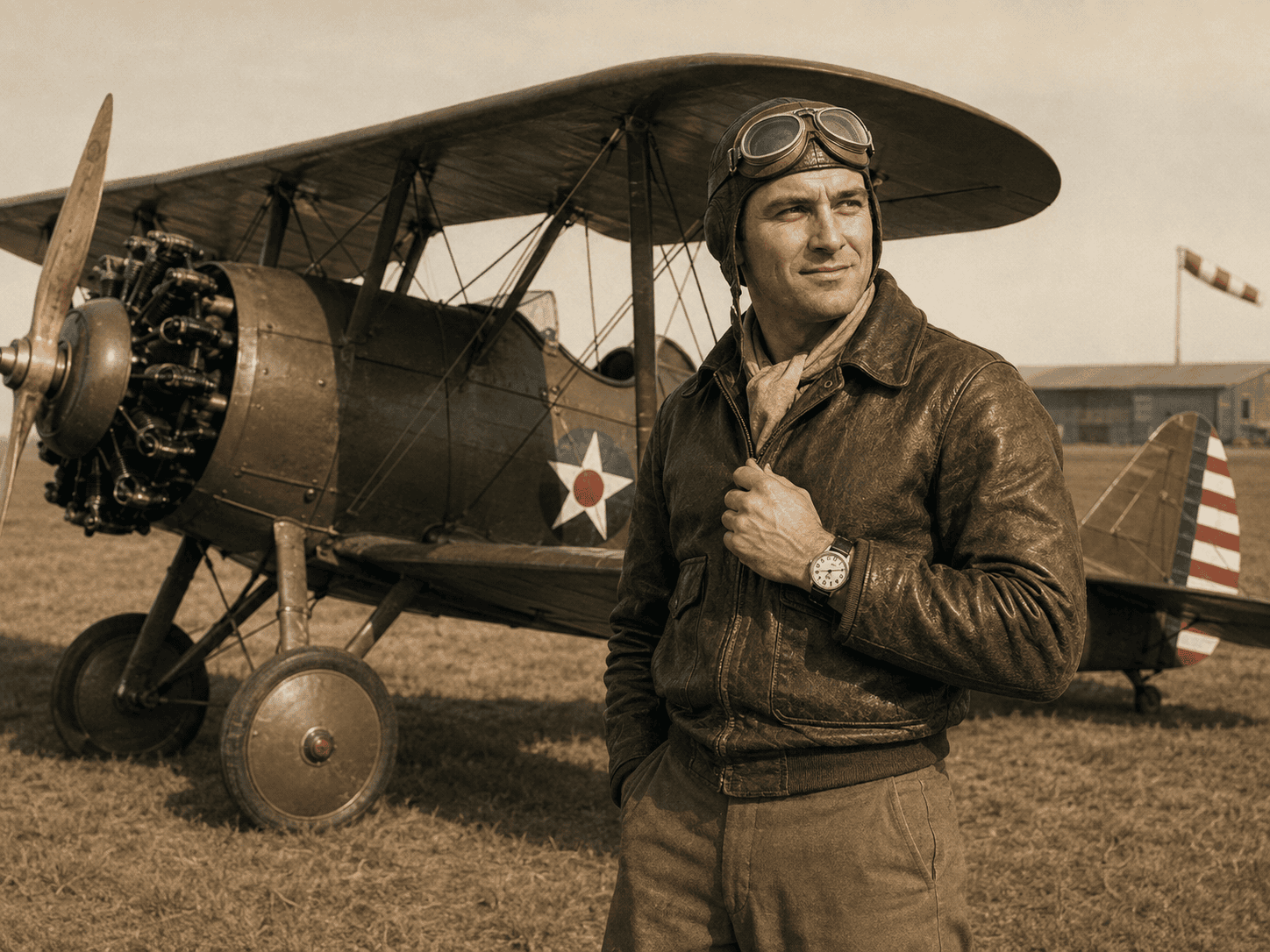
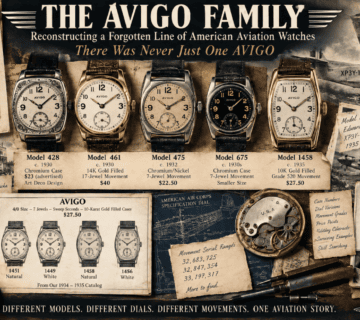
Nearly a century after the first AVIGO wristwatches appeared, surviving examples still look unmistakably like products of aviation’s golden age. Their large numerals and highly legible dials belong visually to a period when pilots were climbing into airplanes with open cockpits, navigation was still an evolving science, and almost every year seemed to produce another flight that pushed the limits of what an aircraft could do.
For years, that made the obvious explanation seem reasonable: AVIGO was an aviation watch.
But while researching the history behind the name for its modern revival, we began finding evidence that complicated that simple explanation.
AVIGO wasn’t merely a wristwatch inspired by aviation.
The name was already appearing inside the aviation industry itself.
And the deeper we followed that trail, the more people began appearing alongside it—engineers, navigators, pilots and military aviators whose careers unfolded during one of the most consequential periods in the history of flight.
Then we found a series of letters from 1928.
Those documents moved the story somewhere we hadn’t expected.
Before the Watch, There Was an Aviation Business
To understand what AVIGO represented in the late 1920s, it helps to forget the wristwatch for a moment.
American aviation in 1928 and 1929 was undergoing extraordinary change. Charles Lindbergh’s transatlantic flight was barely a year old. Airports were appearing across the country. Aircraft manufacturers were pushing airplanes farther and faster, while the Army and Navy were confronting increasingly difficult questions about long-distance navigation, cockpit instrumentation and accurate timekeeping.
Pilots could no longer depend entirely on landmarks and instinct. The airplane was becoming a machine that increasingly had to be flown by information.
That meant instruments.
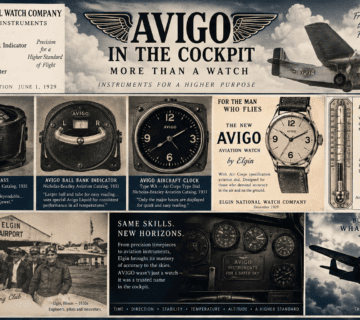
And AVIGO was part of that world.
Contemporary aviation-industry records show an operation that in 1928 was identified as the Tachometer Division and was managed by Gordon C. Gillies. By the following year, the business had expanded.
The 1929 Aircraft Year Book described an extensive line of equipment “known to the trade as ‘Avigo’ instruments.”
That language is important. It wasn’t written decades later by a watch collector attempting to reconstruct AVIGO’s history. It came from the aviation industry during the period itself.
By 1929, AVIGO wasn’t simply a name appearing on the dial of a wristwatch. It was a name associated with aircraft instrumentation.
The wristwatch nevertheless appeared alongside that aviation activity, and a December 1929 national advertisement gives us one of the most intriguing descriptions yet discovered.
Among an assortment of watches, Elgin advertised a $23 AVIGO with the description:
“Elgin Avigo, Air Corps specification aviation dial.”
Those five words—Air Corps specification aviation dial—have become one of the central questions in our investigation.
What specification?
Who developed it?
Was Elgin referring to an actual Army Air Corps requirement governing aviation timepieces or instrument readability? Was it a dial convention adopted from aircraft instrumentation? And why was a commercial wristwatch being advertised using that particular language?
We don’t yet have the answer.
But another set of documents has brought us considerably closer to the world in which that answer may have originated.
The Letters From 1928
Among the papers of one of America’s most important pioneers of modern navigation are documents connecting him directly with Elgin National Watch Company during the period immediately preceding AVIGO’s appearance.
His name was Philip Van Horn Weems.
Weems was no ordinary watch enthusiast. A U.S. Navy officer and navigation innovator, his work helped develop practical methods of celestial and aerial navigation during an era when knowing precisely where an aircraft was located could mean the difference between completing a flight and disappearing.
The Smithsonian’s National Air and Space Museum today preserves the extensive Philip Van Horn Weems Papers, a collection exceeding 100 cubic feet and containing correspondence, photographs, charts, business records and other material documenting his work.
Explore the Philip Van Horn Weems Papers at the Smithsonian
Among the surviving material are remarkable documents from June 1928.
One letter, written on Elgin National Watch Company stationery on June 11, concerns the Weems aerocronometer.
This isn’t a vague business inquiry.
Elgin’s representative asks detailed technical questions about the operation of the timepiece: the purpose of its rotating seconds mechanism, how the minute hand was set, when the watch was adjusted before flight and how it could be synchronized with a master clock.
Then comes perhaps the most revealing request.
Elgin asks whether it might be permitted to inspect one of Commander Weems’ aerocronometers in its existing form.
Two days later, another surviving letter brings the discussion directly into Elgin’s senior leadership.
George Lewis Dickson wrote to Weems’ wife, Margaret, explaining that he was enclosing a letter from DeForest Hulburd, president of Elgin National Watch Company. Dickson described the Elgin people as dependable and expressed his belief that something could be worked out with them as Weems developed a complete system.
Suddenly we are no longer looking merely at a wristwatch advertisement.
We are looking at Elgin, in 1928, directly discussing specialized aviation-navigation timekeeping with the circle surrounding one of America’s most important navigation innovators.
And this was happening only months before AVIGO began appearing in the historical record.
What the Documents Do—and Don’t—Tell Us
It would be tempting to connect those dots immediately and announce that Philip Van Horn Weems helped create AVIGO.
We cannot do that.
Nothing discovered so far establishes that Weems designed the AVIGO wristwatch, chose the AVIGO name, created its dial or was responsible for the “Air Corps specification” language used in the 1929 advertisement.
History deserves more discipline than that.
But the documents establish something significant without any speculation at all: Elgin was actively investigating specialized aviation-navigation watches with the Weems circle during the formative period immediately surrounding AVIGO’s emergence.
And the surviving correspondence goes further.
Another document in the material discusses the Weems organization’s Second Setting Watch and previous correspondence concerning it. The letter describes arrangements involving commercial watch manufacturing while noting that the government possessed rights to purchase watches. It then raises the possibility of Elgin manufacturing watches for government use.
That still doesn’t make the watch an AVIGO.
But it places Elgin directly inside conversations involving navigation watches, specialized timekeeping and potential government watch production.
Against that background, the appearance soon afterward of an AVIGO advertised as having an “Air Corps specification aviation dial” becomes considerably more interesting.
It also gives us a new question to pursue through the archives.
What happened between those conversations in June 1928 and that AVIGO advertisement in December 1929?
The Engineers Begin to Appear
The paper trail isn’t limited to Weems.
Another man emerging from the records is Gordon C. Gillies, who appears in contemporary aviation-industry material as manager of the operation during this crucial period.
We have not discovered evidence establishing Gillies as the inventor or creator of AVIGO, and we don’t intend to give him a title the historical record doesn’t support.
What the records do establish is that he was heading the aviation-instrument operation while AVIGO emerged.
Then there is Victor E. Showalter, whose story takes us even closer to aviation itself.
Showalter’s connection to flight predates the AVIGO wristwatch. An official U.S. Air Service record from 1924 places him aboard an experimental navigation flight from McCook Field as the navigator, working during a period when the military was actively developing better methods of aerial navigation.
Later, Showalter appears as an engineer associated with the aviation-instrument operation in Elgin.
And when Elgin, Illinois, began establishing an airport, historical accounts identify Showalter as responsible for much of the planning necessary to obtain government approval. The same historical account notes the production of tachometers and an AVIGO magnetic compass.
Then comes one of our favorite discoveries in the entire investigation.
Victor Showalter belonged to the Elgin AVIGO Flying Club.
Read the history of Elgin’s early airport and the AVIGO Flying Club
The significance isn’t that belonging to a flying club made someone extraordinary in the 1920s.
It’s what the club tells us about the environment surrounding AVIGO.
The engineers weren’t sitting in a marketing department trying to imagine what aviation looked like. They were working with aircraft instrumentation, developing aviation infrastructure and, in at least Showalter’s case, participating personally in flying.
AVIGO wasn’t watching America’s aviation revolution from a distance.
Its people were living inside it.
From the Instrument Panel to the Wrist
Seen in that context, the AVIGO wristwatch begins to look different.
Without the historical record, it would be easy to dismiss its aviation identity as clever marketing. Lindbergh had made pilots international celebrities. Aviation was exciting and modern, and virtually every industry wanted some association with it.
But AVIGO didn’t need to manufacture an aviation connection.
It already had one.
The name was associated with aircraft instruments. An AVIGO magnetic compass existed. People associated with the operation were involved in aviation engineering and flying. Elgin was corresponding with the Weems circle about specialized navigation timekeeping.
And then a wristwatch appeared carrying the same AVIGO name and was publicly advertised as having an Air Corps specification aviation dial.
We still need the document that explains precisely how those pieces connect.
But several years later, AVIGO’s relationship with aviation produced something we can actually hold in our hands.
A Record Flight and a Gold AVIGO
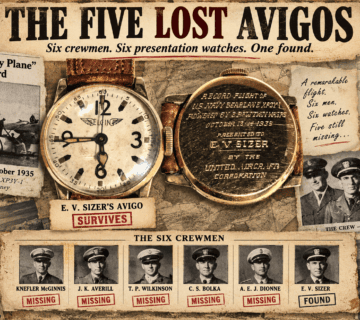
On October 13, 1935, six U.S. Navy aviators departed Coco Solo in the Panama Canal Zone aboard an experimental flying boat known as the XP3Y-1.
They were about to test the limits of a new aircraft.
The crew flew nonstop to Alameda, California, remaining airborne for roughly 34 hours and covering 3,443 miles. The XP3Y-1 would subsequently evolve into the celebrated PBY Catalina, which became one of the most important American flying boats of the Second World War.
Following the flight, United Aircraft Corporation commemorated the achievement with an extraordinary presentation.
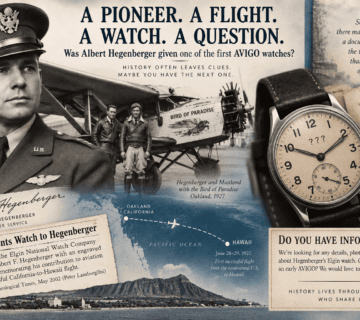
A surviving example belonging to crewman Edward Vernon Sizer is a custom-engraved 10-karat gold AVIGO. Its inscription records the XP3Y-1 record flight, the Pratt & Whitney Twin Wasp engines that powered the aircraft, the October 13–14, 1935 dates and Sizer’s name. The historical account accompanying the surviving watch states that United Aircraft awarded a custom-engraved gold AVIGO to each crewman.
See Edward Sizer’s surviving gold AVIGO and its XP3Y-1 history
Seven years separate the 1928 Weems correspondence from Sizer’s gold watch.
But look at what appears between them.
Specialized aviation-navigation timekeeping. Aircraft instrumentation. The AVIGO name becoming known in the aviation trade. An AVIGO Flying Club. An AVIGO wristwatch advertised with an Air Corps specification aviation dial. And ultimately an engraved gold AVIGO commemorating a record-setting flight by U.S. Navy aviators.
For a name remembered today largely because a handful of old wristwatches survived, that’s an extraordinary trail.
The Mystery Isn’t Solved
If anything, the discoveries have made us more cautious about declaring that we know AVIGO’s complete history.
We don’t.
We still haven’t found the document identifying the person who chose the name AVIGO. We don’t know who designed its original winged emblem. We cannot yet say precisely what Elgin meant by “Air Corps specification aviation dial.”
And although the Weems correspondence dramatically expands the context surrounding AVIGO’s birth, it does not yet prove that Weems participated in designing AVIGO.
That’s precisely why the investigation continues.
The Smithsonian’s Philip Van Horn Weems Papers contain an enormous body of material spanning his life and career, and the National Air and Space Museum describes the collection as reflecting Weems’ extensive work in marine, aerial and eventually space navigation. The Smithsonian notes that Weems would later teach space navigation for the Navy and serve as a consultant to NASA—an extraordinary progression for a man already working on navigation problems when AVIGO was emerging in the late 1920s.
Read the National Air and Space Museum’s biography of Philip Van Horn Weems
We are now seeking additional correspondence from approximately 1928 through 1931 to determine whether AVIGO, aviation watches, aircraft clocks, dial specifications or Army Air Corps requirements appear explicitly in those records.
If they do, another missing piece of the story may finally fall into place.
The Documents Behind This Investigation
We believe historical claims should be open to examination rather than simply repeated until they become accepted as fact.
For that reason, the archival correspondence used in researching this article is referenced below so readers and other researchers can examine the source material themselves.
Among the documents is the June 11, 1928 Elgin letter discussing the Weems aerocronometer in technical detail and requesting an opportunity to inspect one of the devices. Another June 1928 document places Elgin president DeForest Hulburd within the correspondence surrounding the proposed work with Weems.
Archival source: Philip Van Horn (P. V. H.) Weems Papers, Accession 2012.0052, National Air and Space Museum, Smithsonian Institution. That is the Smithsonian’s official citation for the collection.
Editor’s note: Reproductions of the relevant correspondence are provided below for historical and research reference. Readers examining the documents should distinguish between what the surviving records establish and questions that remain under investigation. The documents demonstrate communication concerning aviation/navigation timekeeping; they do not, by themselves, establish that Philip Van Horn Weems designed or created the AVIGO wristwatch.
AVIGO Was There
What began as an attempt to understand an old watch has become an attempt to reconstruct a largely forgotten corner of American aviation history.
That’s a much more difficult undertaking.
The evidence doesn’t arrive in chronological order. One clue appears in an aviation yearbook. Another survives on a gold watch. A name turns up in an Air Service newsletter. An airport history leads to a flying club. Then a nearly century-old letter suddenly reveals that people we’ve been researching were discussing specialized aviation timekeeping with one of America’s important navigation innovators months before AVIGO appeared.
There will undoubtedly be dead ends. There may also be assumptions about AVIGO repeated for decades that the original documents eventually prove wrong.
That’s fine.
We’re not trying to create the best story for AVIGO.
We’re trying to find the real one.
And what the surviving evidence already tells us is remarkable enough.
AVIGO existed in the world of aircraft instrumentation. Its people participated in aviation. Its name appeared on a wristwatch described in 1929 as having an Air Corps specification aviation dial. The company behind it was discussing specialized navigation watches with the Weems circle in 1928. And only a few years later, an AVIGO in gold commemorated men who had pushed an experimental U.S. Navy aircraft into the record books.
The investigation is far from finished.
In many ways, it has only just begun.
But one conclusion becomes harder to escape with every document we uncover.
AVIGO wasn’t created simply to look like aviation.
AVIGO was there.
The following historical correspondence is reproduced from the Philip Van Horn (P. V. H.) Weems Papers, Accession 2012.0052, National Air and Space Museum, Smithsonian Institution. These documents form part of the primary-source research behind this article. Readers are encouraged to examine the original correspondence and draw a distinction between what the documents establish and the questions that remain under investigation.

No comment