
The Forgotten American Aviation Name That Began in 1928
There was a moment in American history when the sky stopped being a boundary.
During the late 1920s, aviation was moving at an extraordinary pace. Aircraft were becoming faster and more capable, airports were appearing across the country, transcontinental air travel was beginning to take shape, and Charles Lindbergh’s 1927 flight across the Atlantic had captured the imagination of millions.
Precision suddenly mattered in an entirely new environment.
Pilots needed instruments they could trust. They needed to know time, direction, altitude, engine speed and pressure while dealing with vibration, darkness, changing atmospheric conditions and the unforgiving reality of flight.
It was into this world that AVIGO was born.
Before AVIGO: The American Watchmaking Giant Behind It
To understand AVIGO, you first have to understand the company that created it.
The Elgin National Watch Company traced its beginnings to 1864, when a group of American businessmen and watchmakers established the National Watch Company near Chicago. Among the original organizers were Philo Carpenter, Howard Z. Culver, Benjamin W. Raymond, George M. Wheeler, Thomas S. Dickerson, Edward H. Williams and W. Robbins. The factory was established in Elgin, Illinois, and the company’s products became so closely associated with the city that the company officially adopted the name Elgin National Watch Company in 1874.
Elgin eventually became one of the great industrial watch manufacturers in American history. For decades, its enormous Illinois manufacturing complex produced watches using advanced machinery, standardized manufacturing methods and interchangeable components on a scale that helped make accurate mechanical timekeeping available to a much larger portion of the American public.
Precision was more than advertising.
In 1910, Elgin even constructed its own astronomical observatory so the company could obtain exceptionally accurate time observations and use them in regulating its watches.
That culture of precision would eventually move from the pocket and wrist into the cockpit.
1928: AVIGO Takes Flight
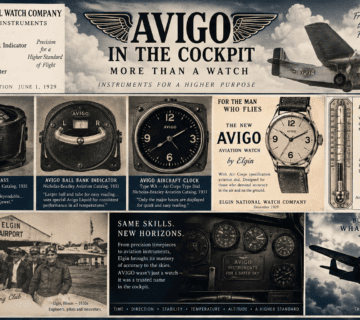
In 1928, Elgin organized a dedicated Aircraft Instrument Division.
Historical accounts of the company identify this as the point at which Elgin adopted the name AVIGO, together with its distinctive winged emblem, for products associated with the new aviation operation.
This is the real beginning of AVIGO.
It was not simply a fashionable aviation-themed watch name pasted onto a dial. AVIGO was connected to an actual program for producing precision equipment for aircraft.
Period aviation literature confirms that Elgin’s Aircraft Instrument Division produced cockpit equipment including aircraft clocks and compasses. One contemporary Aero Digest report described Elgin’s Model CG compass as having been developed to meet requirements of the U.S. Army Air Corps, noting that Air Corps specifications were drawn from the model.
Other period material shows the broader AVIGO instrument family extending into products such as tachometers and fuel-pressure gauges, with aviation catalogs describing equipment constructed to meet contemporary Army and Navy requirements.
AVIGO therefore belonged to something considerably larger than a single watch.
It was part of America’s rapidly developing aviation-instrument industry.
1929: AVIGO Comes to the Wrist
The following year, in 1929, the AVIGO name appeared on wristwatches.
Historical Elgin collector research identifies the 1929 AVIGO line as being designed around an Air Corps-style dial specification, notably using only four prominent numerals to make information quicker and easier to read. The same AVIGO identity was also being used for aircraft gauges and other aviation equipment.
That connection explains the appearance of surviving original AVIGO watches.
Many have highly legible dials, strong numerals, subsidiary seconds, cushion-shaped cases and, most importantly, the extraordinary winged AVIGO emblem.
The logo wasn’t a modern interpretation of aviation heritage.
The wings were there when aviation itself was still young.
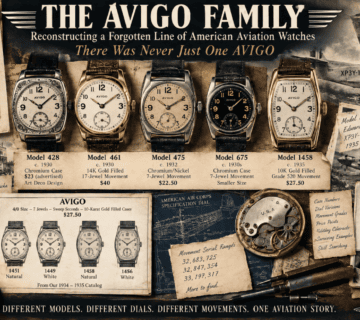
Surviving examples include watches such as the AVIGO 461, which used an Army Air Corps-style dial and was advertised at approximately $40 in 1930—a substantial purchase at the time. Another known AVIGO model, the 426, was listed at $22.50 in 1931.
So What Does “AVIGO” Actually Mean?
This may be one of the most interesting parts of the entire story.
Nobody has yet found a surviving Elgin document that definitively explains how the word AVIGO was created.
Historical researchers who have catalogued Elgin’s watch lines specifically note that there are currently no hard facts establishing exactly what AVIGO stands for.
There are obvious possibilities.
The opening “AVI” naturally suggests aviation, aviator or the Latin-rooted terminology that was appearing throughout the emerging aviation industry. The final “GO” may have been intended to suggest motion, travel or forward movement.
It is an attractive interpretation.
But it remains an interpretation.
Until an original Elgin memo, trademark record, advertisement or internal document is discovered explaining the name, AVIGO’s precise etymology should remain part of the mystery rather than rewritten as fact.
For a brand rooted in nearly century-old aviation history, perhaps that isn’t a weakness.
It is part of the hunt.
Who Founded AVIGO?
There does not appear to have been a single individual who can accurately be called “the founder of AVIGO.”
That distinction matters.
AVIGO appears to have been developed institutionally by the Elgin National Watch Company as part of its 1928 move into aircraft instrumentation. The surviving historical material clearly identifies the Aircraft Instrument Division and AVIGO product program, but it does not presently establish one engineer, executive or designer as the person who personally conceived the AVIGO name and winged emblem.
That means the responsible way to tell the story is not to invent a founder.
Instead, AVIGO should be understood as the product of Elgin’s engineers, watchmakers, instrument specialists and leadership during one of the most important periods in American aviation development.
And there may still be names waiting to be rediscovered.
From Watches to Serious Aviation Instruments
By the early 1930s, references to Elgin “AVIGO” instruments were appearing in aviation publications and catalogs alongside equipment from other important aviation manufacturers.
The products demonstrate why a watch manufacturer belonged in an airplane cockpit in the first place.
Mechanical watches, aircraft clocks, tachometers and other aviation instruments depended upon many of the same disciplines: miniature precision components, gears, pivots, jeweled bearings, calibrated displays and mechanisms capable of functioning accurately despite motion and vibration.
Elgin already knew how to manufacture precision mechanisms in enormous quantities.
Aviation gave those skills a new mission.
The War Years and Elgin’s Aviation Legacy
When the United States entered World War II, Elgin’s expertise in precision manufacturing became even more important.
Elgin suspended civilian manufacturing and devoted production to military needs, producing military watches, chronometers, artillery components, altimeters, aircraft instruments and other precision equipment.
AVIGO’s exact use as a product name during every stage of that later period is less clearly documented, and the AVIGO name eventually faded from common use.
There is no neatly documented date on which someone closed a door and declared AVIGO finished.
It simply became one of the many remarkable names left behind by America’s once-enormous domestic watch industry.
Elgin itself eventually discontinued American watch manufacturing in 1968.
AVIGO became a nearly forgotten chapter.
Nearly a Century Later
The watches survived.
The instruments survived.
The advertisements survived.
And most importantly, the name survived.
Today, AVIGO Watch Company is beginning a new chapter, drawing from that original 1928 aviation heritage while developing an independent modern watch company for a new generation. The company’s current project is documenting concepts, prototypes, engineering decisions and its longer-term effort to build a distinctly American watch company.
The goal isn’t to pretend the company operated continuously for the last hundred years.
It didn’t.
The more interesting story is what actually happened:
An American watchmaking giant created an aviation division in 1928.
It gave that division’s products a new name.
It gave that name wings.
And then, for nearly a century, AVIGO almost disappeared.
Now the story continues.
Born from American watchmaking.
Shaped by the age of flight.
AVIGO — 1928 to the future.

No comment