
To Time the Minutes in the Sky
George R. Hutchinson, the Flying Family, and the AVIGO Presented Before His Greatest Adventures
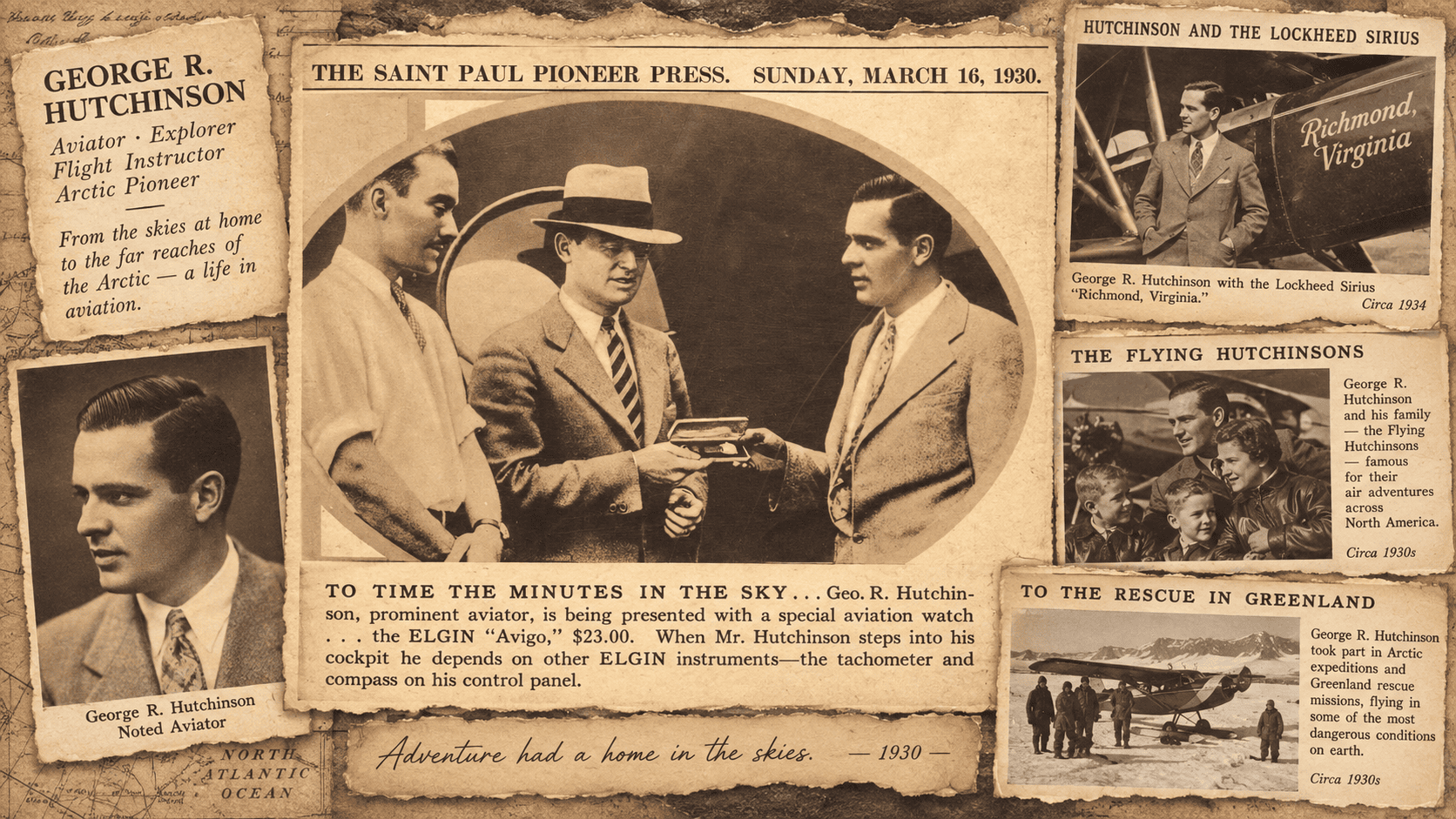
On Sunday, March 16, 1930, readers of the Saint Paul Pioneer Press opened their newspaper to an image that now feels like a small window into the age when aviation was still something daring, unpredictable and new. Three men stood beside an aircraft. In the center, a small presentation box was being opened. Inside was a wristwatch.
The caption began with a wonderfully appropriate line: “TO TIME THE MINUTES IN THE SKY.” The man receiving the watch was George R. Hutchinson, described simply as a “prominent aviator.” The newspaper said he was being presented with a special aviation watch, the AVIGO, priced at $23. Even more interesting was what followed: when Hutchinson entered his cockpit, the advertisement said, he depended on aviation instruments on his control panel—including a tachometer and compass.
At first glance, it is a charming 1930 watch advertisement. Once you learn who George Hutchinson was becoming, however, that photograph takes on an entirely different meaning. The man receiving that aviation watch would soon attempt record flights, own one of the most advanced Lockheed aircraft of the era, fly his wife and young daughters to the capitals of all 48 states, attempt to cross the Atlantic with his family, survive a forced landing off Greenland and become the patriarch of one of America’s most famous flying families.
The AVIGO appears near the beginning of that story.
Before the Flying Family, There Was George
Hutchinson was born in 1902 and came to aviation at precisely the right—or perhaps most dangerous—moment. Charles Lindbergh’s Atlantic crossing in 1927 had electrified the country. Airfields were springing up, flying schools were multiplying and ambitious young pilots suddenly saw an airplane as something capable of connecting cities, states and oceans rather than merely circling a field.
By 1928, Hutchinson was among the men helping build that new aviation infrastructure. Historical research on Philadelphia’s early airfields identifies him as one of the men involved in establishing William Penn Airport at Red Lion Road and Roosevelt Boulevard. The field operated two runways, two hangars and a small fleet of aircraft during aviation’s extraordinary post-Lindbergh expansion.
See the Free Library of Philadelphia’s 1930 photograph of William Penn Airport
Hutchinson wasn’t merely investing in aviation from a comfortable office. He was flying, teaching others to fly and experimenting with exactly the kind of long-distance operations that fascinated America. By 1929, he was already learning just how unforgiving that experimentation could be.
The City of Baltimore and an Attempt That Went Wrong
In September 1929, newspapers across the country were following Hutchinson and an aircraft called the City of Baltimore. He and fellow pilots William L. Snowden and A. G. Graham were attempting an ambitious flight involving aerial refueling.
A contemporary Associated Press report preserved by the University of Oregon describes Hutchinson’s unsuccessful attempt to take on fuel from another aircraft. A gasoline container being lowered from the refueling plane struck the tail of the City of Baltimore and damaged its fabric. Hutchinson abandoned that leg, returned to Wichita Municipal Airport and immediately began talking about another attempt—this time intending to fly west toward Los Angeles and ultimately back to Baltimore. Read the September 5, 1929 newspaper report.
That is an important piece of context for the photograph taken only months later. When Hutchinson was presented with an AVIGO in March 1930, the recipient wasn’t someone who merely liked airplanes. He had already been taking part in the dangerous new world of long-distance and refueling flight. The watch was being placed into the hands of someone actively testing what aviation could do.
A Watch for the Cockpit
The surviving advertisement is unusually specific. It doesn’t merely describe AVIGO as stylish or aviation-inspired. It places Hutchinson beside actual cockpit equipment and explicitly identifies the tachometer and compass as instruments he depended upon when flying.
That small detail is important to AVIGO history because other period material shows the AVIGO name appearing not only on wristwatches but around aviation instrumentation as well. The watch belonged to a moment when pilots were learning to trust an increasing number of instruments in front of them while still needing something equally quick and legible on their wrists.
And Hutchinson was about to need both. Only a few months after that presentation photograph appeared, his ambitions became considerably larger.
He Wanted Lindbergh’s Record
In 1930 Hutchinson acquired a sleek Lockheed Sirius, one of the most advanced aircraft designs of its era. He named the airplane Richmond, Virginia and planned to use it for an attempt to cross the Atlantic faster than Charles Lindbergh had done in 1927.
The airplane was modified for long-distance flying, including additional fuel capacity. Hutchinson’s target was no longer merely another endurance flight around an American airfield. He was thinking about the Atlantic. The Lockheed File preserves a period image of Hutchinson in the cockpit of Richmond, Virginia on July 28, 1930.
A separate Wikimedia Commons image shows Hutchinson on the wing of the same aircraft on July 30, 1930. View the photograph.
The attempt never happened. On August 2, 1930, Hutchinson badly damaged the aircraft in Los Angeles. His transatlantic plans collapsed with it. The Sirius was eventually sold and rebuilt, beginning an extraordinary second life of its own—it later became associated with Sir Charles Kingsford Smith as the Lady Southern Cross.
For some men, wrecking the airplane intended to challenge Lindbergh might have ended the adventure. For Hutchinson, it merely changed the adventure.
Then He Put His Entire Family in an Airplane
By 1931, George Hutchinson was no longer flying alone. His wife Blanche and their young daughters Kathryn and Janet Lee joined him for an undertaking that transformed the Hutchinson name into a national aviation story. Together they became known as the Flying Hutchinsons.
Their objective was extraordinary for the time: visit the capitals of all 48 states by airplane. The Cradle of Aviation Museum records that the family worked together during the flights, helping with navigation, radio and weather information. Their journey had a larger purpose as well. The Hutchinsons wanted to demonstrate that aviation was evolving into a safe, practical form of transportation—not simply a dangerous pursuit for daredevils.
The public fascination was enormous. Here was a husband, wife and two little girls traveling around America by air at a time when many Americans had never been inside an airplane at all. Reporters naturally questioned the wisdom of bringing children along. George and Blanche answered that their daughters were safer in the airplane than they were on city streets.
The family became proof of Hutchinson’s central belief: aviation wasn’t simply the future of adventurers. It was the future of ordinary life.
Greenland Changed Everything
In 1932, Hutchinson pushed that belief far beyond the borders of the United States. The Flying Hutchinsons set out aboard a Sikorsky S-38 amphibian with an even more audacious idea: take the family across the Atlantic and continue an international journey by air.
This time, the ocean nearly won.
The National Park Service records that the Hutchinson family departed on the transatlantic attempt in August 1932 and was forced down off Greenland. Their Sikorsky made an emergency landing, and the family and crew were stranded until a British fishing trawler rescued them.
A later AP archival photograph shows the Hutchinson family being rowed through ice floes to the trawler Lord Talbot after the forced landing. View the archival image.
They had tried to cross an ocean as a family. They came frighteningly close to disappearing into it. Instead, they survived—and the Flying Hutchinsons became even more famous.
From Airplanes to Radio
Their adventures eventually escaped the cockpit entirely. George and Blanche wrote about their experiences. The family appeared in popular culture, on radio programs and promotional material, and their flights were dramatized for audiences who knew them simply as the Flying Hutchinsons. The Cradle of Aviation Museum notes appearances on cereal packaging and radio as their aviation adventures became part of American popular culture.
Their story even reached another generation of American aviation directly through their daughter Janet Lee. The National WASP WWII Museum records that Janet grew up flying with her parents and later became a Women Airforce Service Pilot during World War II, carrying the family’s relationship with aviation into wartime service.
That may be one of the most remarkable parts of George Hutchinson’s legacy. He didn’t simply become an aviator. He created a flying family.
And What Happened to the AVIGO?
That brings us back to March 16, 1930. The photograph survives. The advertisement survives. We can see Hutchinson receiving the box, and the accompanying text explicitly identifies the gift as an AVIGO aviation watch. The same period source links his wristwatch with the tachometer and compass he depended upon in the cockpit.
What we cannot yet establish is just as interesting. We do not yet know who the two men standing with Hutchinson were with sufficient certainty. We have not established the specific achievement or occasion that prompted the presentation. Most importantly, we have not located the actual Hutchinson AVIGO or a later photograph clearly showing it on his wrist.
Those are now research targets rather than reasons to embellish the story. If the watch survived the City of Baltimore era, the Lockheed Sirius plans, the 48-state journey or even the adventures of the Flying Hutchinsons, its provenance could be extraordinary.
But even without locating the physical watch, the 1930 photograph tells us something valuable. George Hutchinson was given an AVIGO before some of the adventures for which history would remember him most. The watch wasn’t presented at the end of his life as a commemorative souvenir. It appears near the beginning of a remarkable aviation story, when Hutchinson was still looking toward the next airport, the next record and eventually the next ocean.
The newspaper called it a watch “to time the minutes in the sky.” George R. Hutchinson would spend the next several years making those minutes count.
Historical Source Image
Original period advertisement used as the primary AVIGO presentation evidence. Keep this with the publishing packet even if the final public article uses only the featured collage.
Source Links for Publication
AVIGO presentation evidence – user-supplied March 16, 1930 newspaper image
Philadelphia-area early airfield history / William Penn Airport
Free Library of Philadelphia – William Penn Airport photograph
University of Oregon historical newspaper – September 5, 1929
The Lockheed File – Hutchinson in Richmond, Virginia
Wikimedia Commons – Hutchinson on Richmond, Virginia
Cradle of Aviation Museum – The Flying Hutchinsons
National Park Service – Floyd Bennett Field historic flights
AP archival image of Greenland rescue, via The Express
National WASP WWII Museum – Janet Lee Hutchinson
Research note: The 1930 presentation image directly supports that George R. Hutchinson was presented an AVIGO aviation watch and that the period caption connected him with cockpit tachometer and compass use. The later biographical material is supported by the linked historical and museum sources. The exact presenter, reason for the watch presentation, and present location of Hutchinson’s watch remain unresolved research questions.


No comment